By Gosia Jaros-White, MA and Michael Herrera, EdD
Adult and continuing education has always been about opening doors, providing opportunities for individuals to re- or upskill, re-enter the workforce, or advance in their careers and gain valuable credentials in the process. Today, the need for high-impact credentialing is greater than ever. In a rapidly shifting labor market, credentials provide visible, portable proof of the skills employers seek. For adult learners, especially those who are multilingual, credentialing can be the difference between underemployment and meaningful career mobility.
The Power of Career-Connected Learning
Research from Georgetown University’s Center on Education and the Workforce (2023) shows that adults with credentials earn significantly more than their peers without them. The return on investment (ROI) for reskilling and upskilling is clear: a recognized credential leads to better jobs, higher wages, and stronger economic security.
For employers, credentials reduce uncertainty in hiring and signal that workers are job ready. For learners, they provide the confidence to compete in a tight labor market. And in adult education, credentialing can improve persistence and program completion by showing learners their progress in tangible, workforce-relevant ways.
Why Language Matters
One of the most powerful, yet often overlooked, assets adult learners bring to the table is language. Almost 66 million people in the U.S. speak a language other than English at home, and about 8% of the population speaks English less than “very well.” Additionally, “the number of people in the United States who spoke a language other than English at home nearly tripled from 23.1 million (about 1 in 10) in 1980 to 67.8 million (almost 1 in 5) in 2019” according to a recent U.S. Census Bureau report. This linguistic reality creates both a challenge and an opportunity: challenge because of a growing need for multilingual employees to serve diverse, multicultural populations, and an opportunity for millions of heritage speakers and multilingual individuals to credential and utilize their language skills on the job.
Yet, too often, language skills go unrecognized.
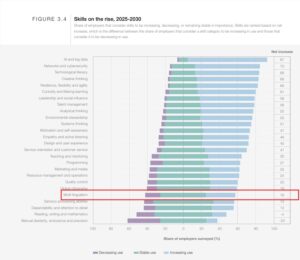
Credentialing multilingual abilities isn’t just about recognition. It’s about economics. Bilingual/Multilingual workers consistently earn 5–20% wage premiums in industries like healthcare, public safety, business, and telecommunications. Beyond wages, the World Economic Forum (2025) highlights multilingualism among the top 20 essential skills for the future, and one that has been consistently growing. Interestingly, other skills such as flexibility, resilience, motivation, and empathy all improve with language learning. In other words, language is a driver of adaptability, cultural competence, and problem-solving skills every employer says they need.
By credentialing language skills, adult education programs can promote both economic mobility for learners and a business advantage for employers.
Language Matters for Employers
Employers are already telling us what they need:
- 9 in 10 employers report needing workers with language skills.
- 1 in 3 employers say they’ve lost business because they lacked multilingual staff.
- Demand is highest in healthcare, trade, education, and technical services, all industries where adult learners are essential to the workforce pipeline.
Credentialing language proficiency creates a win-win: adult learners gain visible, credentialed skills, and employers close costly talent gaps.
ACTFL: The Gold Standard in Language Proficiency Assessments
ACTFL® has long set the global standard for assessing language proficiency. Through its exclusive partnership with Language Testing International® (LTI), ACTFL assessments provide:
- Real-world proficiency measures across multiple languages and levels, from Novice to Superior.
- Recognition in education, government, and workforce systems, ensuring broad portability.
- Legally defensible, internationally recognized credentials, with digital badges issued via Credly.
For adult learners, an ACTFL certificate isn’t just a piece of paper. It’s a powerful signal of readiness for jobs, scholarships, higher education, and professional advancement.
ACTFL in Adult Education
In the adult education space, ACTFL credentialing can serve as a bridge between academic programs and career pathways:
- Placement and credit in English language programs, Career and Technical Education (CTE), and continuing education courses.
- Credit recommendations from the American Council on Education (ACE) that help learners accelerate degree completion.
- Employer recognition that links adult ed programs to career outcomes.
By integrating ACTFL assessments, adult education programs can help learners credential the skills they already have, accelerate progress, and strengthen program ROI.
Building Partnerships and ROI
Employers consistently rank communication and cultural competence as top workforce needs. ACTFL credentials deliver exactly that. By forming partnerships among adult education programs, employers, and workforce boards, we can:
- Create hiring pipelines where credentials mean job readiness.
- Offer wage premiums and career advancement opportunities for multilingual workers.
- Demonstrate measurable ROI to funders and policymakers.
Overcoming Challenges
While the benefits are clear, adoption requires overcoming barriers:
- Barrier: Learners unsure how credentials translate.
Solution: Build employer partnerships and share success stories. - Barrier: Funding assessments.
Solution: Leverage grants, workforce boards, and employer sponsorships. - Barrier: Limited awareness in adult education.
Solution: Provide professional development and advocacy to program leaders.
Looking Ahead
The demand for multilingual skills will only grow. Adult learners represent an untapped talent pipeline, and ACTFL credentialing offers a scalable, equity-focused solution. Programs affiliated with organizations like the American Association of Adult and Continuing Education (AAACE) are uniquely positioned to lead nationally by integrating high-impact credentialing into adult education and workforce systems.
A Call to Action
To unlock this opportunity, adult and continuing education programs should:
- Recognize and credential adult learners’ multilingual skills.
- Integrate ACTFL assessments into English language programs, CTE, competency-based, and workforce programs.
- Partner with employers and workforce boards to ensure credentials translate directly to jobs.
- Position themselves as leaders in equity and innovation through language credentialing.
What Success Looks Like
Success means:
- Adult learners with portable, employer-recognized credentials.
- Employers with skilled, multilingual workforces ready to compete globally.
- Programs demonstrating higher persistence, completion, and ROI.
- Communities and economies strengthened by diverse, credentialed talent.
Key Takeaways
- Language proficiency = workforce advantage.
- ACTFL credentials = visible, portable proof of skills.
- Adult learners benefit most from equity-focused credentialing.
- Adult and continuing education programs can lead this transformation nationwide.
High-impact credentialing isn’t just about degrees or certificates. It’s about providing adult learners with the tools they need to thrive. By recognizing multilingual skills through ACTFL and LTI, we can create meaningful pathways to opportunity and economic growth.
Ready to bring language credentialing to your program? Contact us to get started.