John Papa, an HR generalist and US Air Force National Guard, had always been fascinated by the power of language. Growing up in a Filipino household in the United States, he had learned both English and Tagalog from a young age. But it wasn’t until he started working as a human resource generalist for a nonprofit organization that he realized just how valuable his bilingual skills were.
John’s organization had recently introduced a new program to promote diversity and inclusivity in the workplace, and part of that program included language proficiency testing. John certified his Tagalog speaking proficiency with the ACTFL OPI®, and to his delight, he achieved the Superior level.
“It was challenging, for sure,” John admitted. “But it was also a great feeling to be able to test my abilities in Tagalog and prove to myself that I was fluent.” John’s bilingualism had already opened up new opportunities for him at work. He had served as a translator for clients who couldn’t speak English, and he had even been able to help his organization develop new programs and initiatives to better serve the diverse community it worked with.
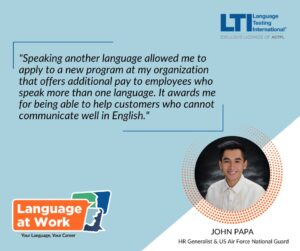
But John knew that his language skills could also be useful outside of work. He often found himself helping strangers who were struggling to communicate in English, whether it was a tourist in need of directions or a non-English-speaking customer at the grocery store.
“It feels good to be able to help someone out just by using your language,” John said. “And it’s not just about practical benefits. It’s also about making connections with people and building bridges between cultures.”
John’s passion for language learning didn’t stop with Tagalog. He had also taught himself some Spanish, which he found easier to learn because of its similarities to Tagalog. And he had even picked up some American Sign Language. “One time I went to the post office,” John recalled. “And one of the workers there was deaf. I said thanks in ASL, and he was surprised and happy. Being included and being inclusive is so important nowadays. By saying simple words like thank you in someone’s language makes a huge impact and it keeps us closer together and feeling included.”
For John, being bilingual wasn’t just a practical skill or a way to get ahead in his career. It was a way of connecting with others and building a more inclusive society. He encouraged others to take the leap and learn a new language, even if they were intimidated by language testing and certification. “Just do it,” he said. “Regardless of the results, you’ll still have learned something. And who knows? Your language skills could help you make a difference in someone’s life someday.”