Note: This article was written based on a recorded interview with Dr. Lucia Osa-Melero, Associate Professor and Director of the Center for Hispanic Studies at Duquesne University.
It was more than fifteen years ago when a simple question sparked what would become a transformative partnership at Duquesne University: Could nursing students take an elective in Spanish for medical purposes?
Posed by the School of Nursing to what was then the Department of Modern Languages and Literature, that question planted the seed that grew into a full-blown, three-semester micro-credential course and a model for how language education can directly support workforce readiness in healthcare.
A Partnership Born from Need
The original course began modestly: one elective section of “Spanish for Medical Purposes,” enrolling 10–15 highly motivated nursing students interested in expanding their Spanish abilities each semester. For many, the course served as preparation for a service trip to Nicaragua, where students supported communities with medical needs. The results were immediate and compelling. Students reported high satisfaction, strong engagement, and clear real-world value.
Over the next few years, the program evolved in response to societal changes. Growing linguistic diversity in U.S. healthcare settings made the demand for Spanish increasingly urgent. At the same time, structural changes within the university, most notably the removal of foreign language requirements after the pandemic, placed pressure on language programs to rethink their role.
“It was the right moment,” recalls Dr. Lucia Osa-Melero, Associate Professor and Director of the Center for Hispanic Studies at Duquesne. “We [the language department and the nursing school] needed each other. The School of Nursing saw the need for Spanish in clinical contexts, and we needed students. We combined forces.”
That collaboration turned Spanish for Healthcare into a required one-semester course for all nursing students. Eventually, it grew into something even bigger.
From Course Sequence to Micro-Credential
Today, the Spanish for Healthcare program consists of a three-semester sequence that forms a nine-credit micro-credential, Duquesne’s official term for an educational certificate. The structure is intentionally progressive:
- Spanish for Healthcare I (Required): Introduces foundational language and communication skills tailored to clinical settings.
- Spanish for Healthcare II (Elective): Builds on those skills with more advanced scenarios and vocabulary, offered at times that accommodate nursing students’ tightly structured schedules.
- Spanish for Healthcare III (Capstone – Study Abroad): A three-week immersive experience in Costa Rica, developed in partnership with Universidad Veritas.
The capstone is where everything comes together. Students live with host families, attend daily Spanish classes focused on healthcare communication, and participate in community-based medical, nutrition, and public health activities.
“It was clear to me that the third semester had to be immersive,” says Dr. Osa-Melero. “They start here, but they have to finish abroad.”
Spanish as a Clinical Tool
What makes this program distinctive is its framing. Spanish is not treated as a traditional academic subject, but as a clinical tool; one more skill nurses can use to provide better care to their patients.
“That’s when students wake up,” Dr. Osa-Melero explained. “This isn’t about memorizing conjugations. This is another tool in your nursing toolbox.”
Instruction emphasizes oral communication with some focus on writing as well. Role-plays, simulations, and real-world scenarios dominate the classroom. Students rehearse patient intakes, symptom descriptions, and care instructions. They also practice with trained speakers of Spanish through virtual conversation platforms, strengthening confidence and fluency.
The goal is not full bilingualism, but functional, confident communication, enough to initiate conversations, reduce patient anxiety, and improve accuracy in care.
“When a nurse can address a patient in Spanish, patient anxiety goes down,” said Dr. Osa-Melero. “Patients open up. Information flows more easily. Care improves.”
Impact on Confidence, Equity, and Career Readiness
The impact on students has been profound. Surveys from the Costa Rica capstone trip show dramatic increases in confidence, willingness to initiate conversations with Spanish-speaking patients, and motivation to continue learning. Students report moving from hesitation to eagerness, from fear to empowerment.
The program also reinforces Duquesne’s commitment to patient-centered care and health equity. By addressing language barriers directly, students learn to meet patients where they are linguistically, culturally, and humanly.
A Model for Cross-Disciplinary Collaboration
For Dr. Osa-Melero, the success of the program offers a clear lesson for other institutions: relationships matter.
“Face-to-face conversations with deans, faculty, and administrators went much farther than emails,” she said. “And data matters: student surveys, testimonials, proof of impact.”
From pilot phases to orientation presentations, from flyers to social media outreach, building the program required persistence, creativity, and advocacy. But the payoff has been worth it.
“Now,” she says, “we’re enjoying the results of the work we put in years ago.”
Looking Ahead
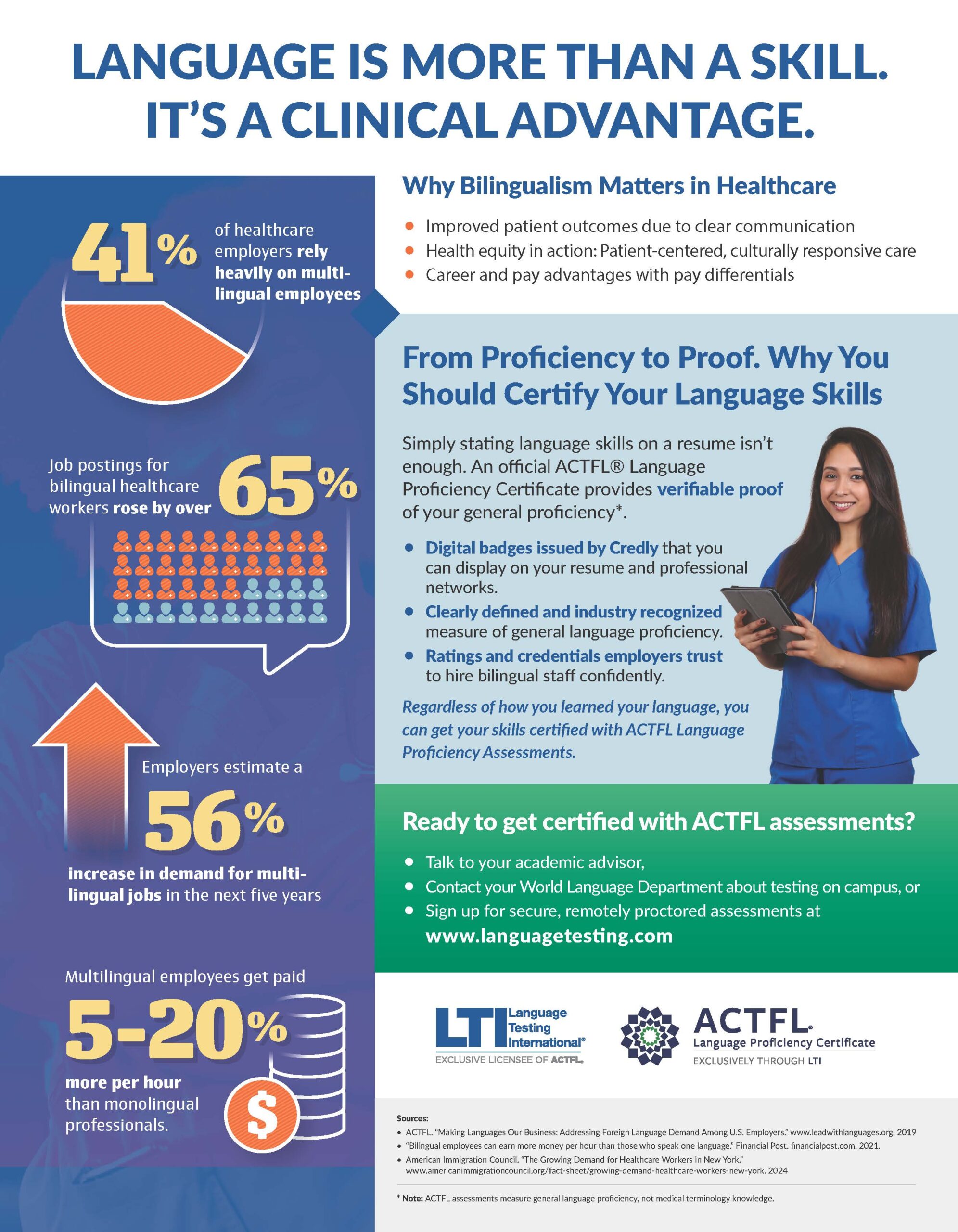 Looking ahead, the program is exploring pairing this powerful learning pathway with official credentialing. One natural next step is to offer students the opportunity to assess their Spanish skills with an ACTFL assessment such as the OPIc. While the micro-credential signals meaningful training and completion, an external proficiency rating gives students a clear, industry-recognized measure they can present to employers with confidence. Add in a Credly digital badge, something students can display on LinkedIn and share directly with hiring managers, and the value becomes even more tangible.
For graduating nurses entering fast-paced, multilingual clinical environments, that combination can be a real differentiator, helping them stand out as candidates who are not only committed to patient-centered, equitable care, but also able to document the language skills that make it possible.
Are you looking to implement a language program for healthcare students and/or bring industry-recognized language credentials to your healthcare students? Language Testing International has great resources and checklists that can help with implementation. You can download them here.
Download the student poster here.