A spoonerism is a mispronunciation of a short phrase. It occurs when a person swaps word sounds while verbalizing two or more words. “Take a shower” becomes “shake a tower” when the brain’s speech center momentarily causes confusion or a person loses focus while speaking. While spoonerisms are common in English, they can occur in any language.
What Is a Spoonerism?
A spoonerism is a sound transposition that mixes sounds in a short phrase involving two or more words. It occurs when an individual uses a phrase or word’s initial sounds interchangeably. People may switch parts of words or phrases, such as vowels and consonants. For example, someone may say “cast far” when they mean to say “fast car.”
People sometimes mistake a spoonerism for a malapropism, but malapropisms are different. A malapropism is when an individual uses a word incorrectly. For example, someone may say “apprehend” when they mean to say “comprehend.”
Where Did the Name “Spoonerism” Come From?
The term “spoonerism” was coined after William Archibald Spooner. Spooner was a clergyman and a New College of Oxford University dean and professor. He was a well-respected member of the university’s staff, but he was also well-known for swapping parts of different words with each other.
Spooner frequently mispronounced phrases, switching parts of words during speeches and gatherings. For example, he once reprimanded a student, saying they “hissed my mystery lecture,” not “missed by history lecture.” Because he mispronounced words frequently, people eventually started calling these verbal errors “spoonerisms.”
Do Spoonerisms Happen in Other Languages?
Spoonerisms happen in other languages, too. A spoonerism occurs when a person switches different sounds, so it can happen while speaking any language.
German Schüttelreimes are poetic devices combining spoonerisms and rhymes. A poet intentionally uses a Schüttelreime to take the final two words’ consonants in one line and swap the same consonants in the following line. For example, one line may read, “A loud and rambunctious bold cat,” while the subsequent line reads, “may find itself struck with a cold bat.”
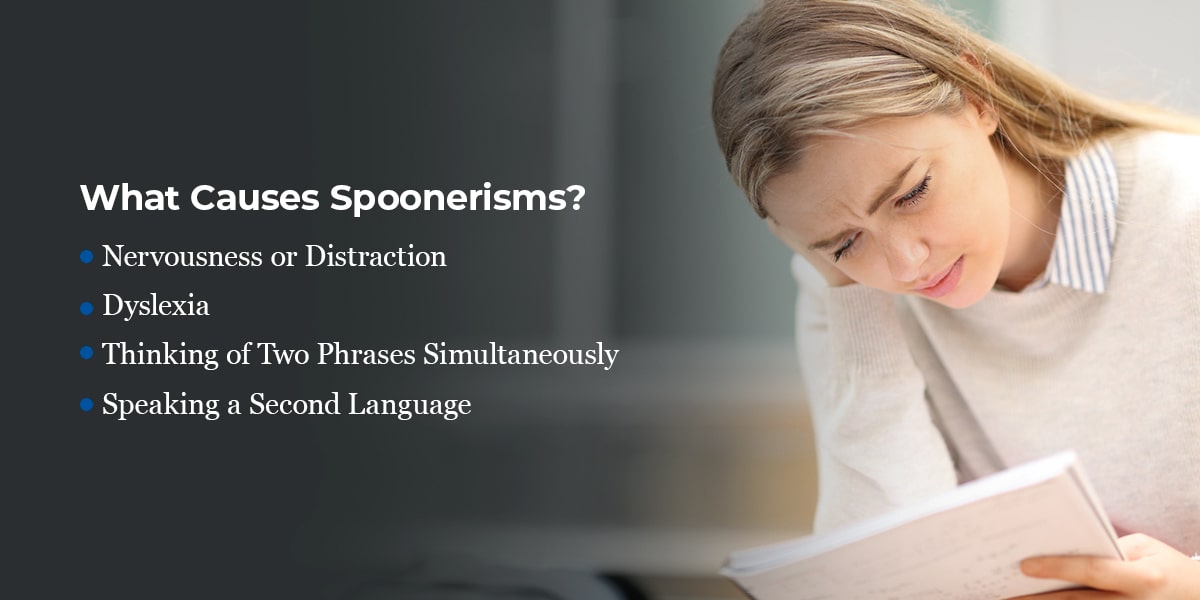
What Causes Spoonerisms?
Spoonerisms occur when the part of the brain controlling speech momentarily causes confusion and switches a phrase’s sounds as a person verbalizes them. The following factors can cause or increase spoonerisms:
Nervousness or Distraction
People often say spoonerisms when they talk too fast, lose focus, or become distracted while talking. A nervous tick can increase the chances of saying spoonerisms and the frequency of these errors.
Dyslexia
Dyslexia can also increase the chances of verbalizing spoonerisms while speaking. Individuals with dyslexia have reduced use of their brain’s sound categories. This limited access to sound categories can cause people to mispronounce words and swap word sounds.
Thinking of Two Phrases Simultaneously
Speech errors can also occur when an individual says a phrase before deciding which phrase they want to say. Their brain may activate two competing phrases or speech plans simultaneously, causing a person to mix up the phrases and sounds they’re trying to say.
Speaking a Second Language
A spoonerism may also be more likely when a person is speaking a second language. You may mix word sounds while speaking a second language because you’re less familiar with it than your primary language.
How to Prevent Spoonerisms
If you want to prevent spoonerisms, you can practice speaking slowly and clearly. You can avoid spoonerisms in a second language with frequent practice. Speaking a second language out loud makes the correct pronunciation and usage feel more natural, and you can get used to how the words should sound when you speak them.
Give yourself time to enunciate each word when you talk. Practicing before giving a speech or taking a language test can help you reduce nervousness and help you remain focused when you need to speak.
25 Examples of Spoonerisms
Some spoonerisms are minor and may go unnoticed, while others can be funny or embarrassing. A phrase’s context determines how funny a spoonerism is because switching sounds in words can change the phrase’s meaning. Spoonerisms can also be intentional.
Consider the following spoonerism examples to understand this type of linguistic error:
Short Spoonerisms
Short spoonerisms occur in two-word phrases, such as the following:
- “Sad ballad” for “bad salad”
- “Belly jeans” for “jelly beans”
- “Trail snacks” for “snail tracks”
- “Brunday sunch” for “Sunday brunch”
- “Chork pops” for “pork chops”
- “Plaster man” for “master plan”
- “Treach bip” for “beach trip”
- “Barter wottle” for “water bottle”
- “Heaving loam” for “leaving home”
- “Chilled greese” for “grilled cheese”
- “Drain bamage” for “brain damage”
- “Bamburger huns” for “hamburger buns”
Long Spoonerisms
The following longer examples of spoonerisms are also amusing:
- “Cakeing a bake” for “baking a cake”
- “Criving the dar” for “driving the car”
- “Chewing the doors” for “doing the chores”
- “A lack of pies” for a “pack of lies”
- “Shake a tower” for “take a shower”
- “Chipping the flannels” for “flipping the channels”
- “Wave the sails” for “save the whales”
- “Flock of bats” for “block of flats”
- “Bead a rook” for “read a book”
Famous Spoonerisms
Spooner verbalized some famous spoonerisms, and individuals verbalized other well-known spoonerisms in popular churches. Consider the following famous spoonerisms:
- “Excuse me, but you are ocoupewing my pie.” for “Excuse me, but you are occupying my pew.”
- “Sew this gentleman into a sheet.” for “Show this gentleman into a seat.”
- “Kistomary to cuss the bride.” for “Customary to kiss the bride.”
- “Jonah in the bale’s whelly.” for “Jonah in the whale’s belly.”
Are Spoonerisms Ever Intentional?
Some authors use spoonerisms intentionally to create funny books and short stories, such as “Runny Babbit” by Shel Silverstein. Others may use spoonerisms deliberately to make a joke or perform a comedic monologue. Comedians can use spoonerisms to say slightly inappropriate phrases without saying the actual words, allowing the audience to make humorous connections while listening.

Certify Your Language Proficiency With Language Testing International
Spoonerisms are common in any language. Whether you speak too quickly, lose focus while talking, speak a second language, or struggle to categorize sounds cognitively, a spoonerism can alter what you try to say or result in some humorous wordplay. You can prevent spoonerisms by practicing pronunciation and enunciating words at a steady pace.
Language proficiency is an excellent skill, and it can present new career opportunities. ACTFL assessments evaluate language proficiency in speaking, reading, writing, and listening. Language Testing International® (LTI) is the exclusive licensee of ACTFL language tests, and we deliver proficiency tests in over 120 languages. Contact us to learn more about ACTFL language assessments and how LTI can help you earn language proficiency certification.