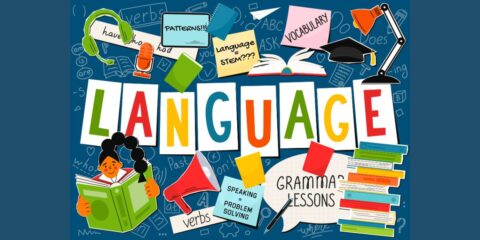
I’ve always been a left-brained math and science guy who loves rules, systems, and geometric proofs, which is why I’ve never quite understood my own proclivity towards the humanities, literature, storytelling, and languages. And yet, since the myth of brain hemispheres has long been debunked, why has no one exorcised the lingering haunts that foreign language proficiency is something attained only through creativity, tone, pattern recognition, emotional intelligence, culture, music, stories, and all the other skills, features and functions we associate with the soft sciences and humanities? In the past decade, educators have put a lot of stock, importance, and in many cases inordinate funding, into STEM—a clever acronym that pulls together science, tech, engineering, and mathematics—but somehow, linguistics and language learning has been shortsightedly left out.
The irony, of course, is that language learning is one of the most system-driven disciplines we teach. Strip away the outdated image of vocab lists and verb charts, (if you can even still picture language acquisition in that way!) and what’s left is a network of patterns, rules, and structures that students must learn to navigate, manipulate, and apply in real time. Syntax, morphology, agreement, register, tone—each layer operating within its own logic, all interacting simultaneously. In other words, language is as expressive as it is computational. Students of a world language are running a constant system, calculating how meaning is built, adjusted, and understood.
How STEM Could Actually Become MELTS (Math, Engineering, Language, Technology, Science)
We’ve long since abandoned any notion that language proficiency consists of memorizing forms, having now recognized the importance of identifying patterns, predicting outcomes, and applying rules across contexts. If you can agree with that sentiment, then arguably, language is basically just math with words instead of numbers! Verb conjugations aren’t all that different from a formula; a sentence structure isn’t so far from an equation. My best language students, the nerdiest ones, test what happens when they change one element, observe the result, and refine their understanding. Again, pattern recognition, systems thinking. All computational-style nerding out.
Let’s pivot to science and engineering next: in the same vein, every attempt to communicate is a test case–an experiment, if you will. Students try something, get feedback—sometimes explicit, sometimes just a confused look—and adjust. I make sure to avoid directly correcting them, because in most real-life applications, people could respond with a wide variety of reactions, only one of them being a corrected reiteration of their interlocutor’s message. So, the student rephrases, simplifies, expands, and tries again. It’s the “build, test, revise” approach. It’s the engineering design process, just happening in conversation instead of a lab.
In a live conversation, students are processing input, selecting structures, generating output, and adapting on the fly. I love when a student gets nervous in a recording and wants to hit pause in between sentences: there’s no pause button! No debugger! When something breaks, speakers of a language must patch it in real time—switching vocabulary, restructuring sentences, leaning on verbal and nonverbal context. Utilizing a language (especially not one’s first or native tongue) is live processing under pressure, and it demands both precision and flexibility.
You can see this most clearly in a classroom when a student hits a wall mid-sentence. They pause, pivot, and rebuild the idea with the tools they have. They naturally ask me for a solution, but I’ll often refuse to give them a word, so they have to describe around it. Maybe the structure of their intended communication collapses, so they’re forced to simplify and try again. And then, on a good day, I get to see the moment it clicks. The idea lands and “communication” happens.
So yes, if I ran the educational word, I’d toss out the tired acronym of STEM and offer MELTS.
The Case for Testing Differently
If we can get behind language learning as a system, then we should assess it the way we assess other complex skills—not by what students remember, but by what they can do. In STEM classrooms, we don’t stop at definitions or formulas; we ask students to apply them, to test them, to use them to solve problems. And that’s how I run my classes; my quizzes have long since left behind simple vocabulary matching, and rely very little on fill-in-the-blank exercises; even at early levels, my assessments are built around tasks, prompts, and real-life scenarios.
Performance-based assessments like the AAPPL operate in that same space. They don’t ask students to recall isolated rules; they ask students to apply language in context—interpreting meaning, engaging in conversation, and communicating ideas in ways that resemble real-world use. The question shifts from “What do you know?” to “What can you do?” Earning the Seal of Biliteracy serves as a kind of certification—not one saying they’ve completed a sequence of courses, but one that proves they can operate within that system across languages. I like to think of it as a demonstration of applied skill, not just accumulated knowledge.
Equity for Language Learning
I think that hiding underneath all of this, there’s also an access question. When language programs are treated as optional or secondary, in the sad way that music and arts so often get the axe, fewer students stick with them long enough to reach real proficiency. The result is that multilingualism—one of the most valuable skills in a global economy—becomes something reserved for a smaller group of students, rather than a core outcome for all. And above all, I’d argue that students in the United States are among the greatest victims of this pernicious situation.
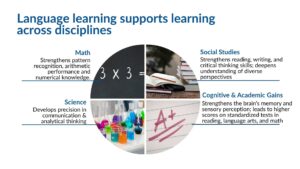
If we’re serious about preparing students for the future, we can’t afford to treat communication across languages as a luxury, or look down on them as some kind of frivolous hobby. Language proficiency belongs alongside the very skills we’ve already decided to prioritize when we continue to perpetuate the importance of STEM. And yet, despite all of this, language programs continue to be treated like electives—flexible, compressible, sometimes even expendable when schedules get tight, while STEM courses are protected, prioritized, and resourced. Language courses are too often asked to fit in around the edges.
But maybe the issue isn’t that language doesn’t belong in STEM; maybe it’s that we’ve been defining STEM too narrowly. Because when students are recognizing patterns, testing hypotheses, solving problems in real time, and applying a complex system to communicate across cultures, they’re not just learning a language. They’re engaging in the kind of thinking we claim to value most. What scientists, engineers, and mathematicians do, language learners do too—just in another language.
Bring AAPPL to your school and district today. Contact us.
Sources:
Collective Learning. “Why is learning world languages essential for global education?” https://www.collectivelearning.info/blog/world-language-learning-global-education.
Espinal, D., Fuchs L. “The Effects of Language Instruction on Math Development.” National Library of Medicine. https://pmc.ncbi.nlm.nih.gov/articles/PMC9053617.
Kennedy Krieger. “How do Language Skills Impact Math Learning?” https://www.kennedykrieger.org/stories/linking-research-classrooms-blog/how-do-language-skills-impact-math-learning
Social Studies. “Literacy Across the Social Studies Disciplines: A Framework to Support Your Classroom.” https://www.socialstudies.com/blog/literacy-across-the-social-studies-disciplines-a-framework-to-support-your-classroom.
The Open University. “The importance of language skills.” https://help.open.ac.uk/developing-academic-english/the-importance-of-language-skills.