What is Perkins V?
Perkins V (officially Carl D. Perkins Career and Technical Education Act) provides federal funding to states and local school districts to strengthen career and technical education (CTE). The legislation emphasizes raising both academic and technical outcomes for CTE students, improving alignment between secondary and postsecondary education, and increasing accountability. Through Perkins V, states and communities can advance their own CTE priorities, such as supporting students from early career exploration through career preparation, while responding to evolving workforce and economic demands.
Perkins V is meant to answer one big question:
Are students leaving school with skills they can actually use for jobs or further training?
Perkins V is not for general education alone. It also prioritizes :
- Career pathways
- Workforce preparation
- Skills that employers value
- Meaningful credentials for career success
What is Perkins funding used for?
Perkins funds can be used to support:
- Career readiness programs (K-12 and postsecondary)
- Industry-recognized credentials
- Assessment of technical and employability skills
- Data collection and accountability
- Equity and access (special populations)
- Alignment between education and workforce needs
Perkins is focused on outcomes. Programs utilizing these funds must show evidence that students are gaining measurable, usable skills.
What are the Perkins V indicators?
Perkins V indicators are focused on several priorities, such as:
Career readiness & employability: Students should graduate with demonstrable skills, not just course completion. Programs must prepare learners for successful employment.
Secondary and Postsecondary CTE Program Quality: Programs must ensure students are developing skills aligned to labor market needs.
Accountability & Performance Indicators: States and districts must report measurable outcomes tied to student success.
Equity & Access: Programs must ensure all learners (especially special populations) have equitable access to high-quality CTE.
Program Improvement & Continuous Evaluation: Programs must use data to evaluate and improve CTE programs.
Employer & Workforce Alignment: CTE programs must align with employer needs and regional labor markets.
Credential Attainment: Programs must increase the number of learners earning recognized credentials.
Where do language skills fit into Perkins?
As the demand for multilingual workforce is growing, language proficiency has become a workforce skill. In many career pathways, language skills support customer service, healthcare, education, public service, business, tourism, logistics, international trade, community engagement, law enforcement, construction, and many more.
Perkins allows funding to be used when language skills are tied to career pathways, employability, and industry or workforce readiness.
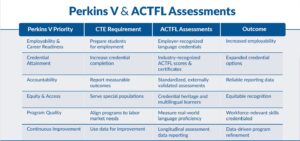
Why do ACTFL proficiency assessments align so well with Perkins V?
ACTFL® assessments, delivered exclusively through Language Testing International® (LTI), support key Perkins V requirements by measuring language proficiency as it can be used as a career-ready skill.
ACTFL assessments measure what learners can actually do.
Perkins Focus: Employability.
Perkins focuses on preparing learners for successful employment. ACTFL Assessments:
- Certify language proficiency that employers recognize and trust.
- Support placement into bilingual roles and internships.
- Reinforce employability skills such as communication, problem solving, and cultural competence.
Value to CTE Leaders:
- Students graduate with portable, employer-facing credentials.
- Language skills become visible, verifiable assets in the job market.
ACTFL assessments provide recognized credentials.
Perkins Focus: Credentials attainment.
Perkins values industry-recognized credentials. ACTFL assessments:
- Produce ACTFL scores and certificates– industry-recognized credentials.
- Are recognized across education, government, and industry sectors.
- Can be embedded at program completion or graduation.
Value to CTE Leaders:
- Expands the definition of credential attainment
- Increases student unique value proposition at graduation
ACTFL assessments support data, accountability, and reporting.
Perkins Focus: Perkins performance indicators.
Perkins requires programs to show measurable outcomes. ACTFL assessments provide:
- Standardized, externally-validated proficiency-based assessments.
- Consistent measurement across programs, schools, and districts.
- Longitudinal data to track skill growth over time.
- Clear documentation, such as assessment reports and data visualization.
- Skill-specific data (speaking, writing, reading, listening).
Value to CTE Leaders:
- Reliable data for local and state reporting
- Clear evidence of skill attainment beyond technical competencies
ACTFL assessments support equity and access goals.
Perkins focus: Equitable skills recognition.
Perkins emphasizes serving special populations. ACTFL assessments:
- Measure proficiency independently of how or where the language was learned.
- Recognize and credential skills heritage speakers already have.
- Provide credentialing opportunities for multilingual learners.
- Are delivered on WCAG 2.1 AA compliant platforms, and streamlined accommodation processes are also available.
Value to CTE Leaders:
- Promotes equity by validating skills students already possess
- Avoids bias inherent in self-reported language ability
ACTFL assessments measure real-world language proficiency.
Perkins focus: Program quality.
Perkins requires programs to ensure students are developing skills aligned to labor market needs. ACTFL assessments:
- Measure real-world language proficiency, not seat time or course completion.
- Measure real-world communication required in high-demand industries (healthcare, public safety, hospitality, human services, government).
- Provide credentials alongside technical certifications.
Value to CTE Leaders:
- Demonstrates that language instruction contributes directly to employability
- Strengthens program relevance and credibility with workforce partners
ACTFL assessments provide data-rich reporting.
Perkins focus: Program improvement & continuous evaluation.
Perkins values data that evaluate and improve CTE programs. ACTFL assessments provide:
- Data-rich reporting at student, program, and district levels.
- Insights to refine instruction and pathways.
- Evidence to inform program expansion or redesign.
Value to CTE Leaders:
- Turns assessment into a decision-making tool
- Supports continuous improvement cycles
ACTFL assessments are based on recognized standards.
Perkins focus: Employer & workforce alignment
Perkins focuses on alignment with employer needs and regional labor markets. ACTFL assessments:
- Provide proficiency levels that are widely understood across market sectors.
- Provide legally defensible assessments appropriate for high-stakes workforce decisions.
- Support partnerships with employers offering bilingual incentive pay.
Value to CTE Leaders:
- Builds trust with employers
- Strengthens work-based learning and placement outcomes
Summary: Language is a Perkins-aligned asset
Perkins V funding can be used to assess and credential language skills with ACTFL assessments because they provide validated, real-world evidence of career-relevant communication skills, exactly the kind of measurable, portable outcomes Perkins V is designed to support.
Language is an asset. Perkins V demands that assets be measured, documented, and delivered. Contact us to bring language credentials to your organization to meet the demands of Perkins V.