A language proficiency assessment measures how well you can use a language in real-life conversations or applications, regardless of how you learned it. Understanding how to prepare for a language proficiency test helps you sharpen your skills and increase your chance of getting a higher score. Since these proficiency-based tests focus on what you can do with a language, practice is more important than memorization. You must dive beyond vocabulary and use strategic preparation to become comfortable in your target language.
Test Formats and What to Expect
Different language proficiency tests have different formats. Familiarizing yourself with your upcoming test’s format can boost confidence and help you increase your success. Be aware of the following variations amongst tests:
Delivery Method
Some tests are live, while others are computer-based. A live test, such as the ACTFL Oral Proficiency Interview (OPI), involves a live phone call with an ACTFL-certified tester. The assessment is a one-on-one conversation. This format allows the tester to adapt their questions to your ability in real time. This method captures the nuances of spontaneous, interactive speech.
A computer-based speaking proficiency test, such as the ACTFL Oral Proficiency Interview by Computer (OPIc), uses a virtual avatar to ask prerecorded questions. It simulates a live conversation without needing a live tester. During this type of assessment, you record your answers to the prerecorded questions. ACTFL-certified raters then score your responses and assign a rating.
The ACTFL Writing Proficiency Test (WPT) measures how well you can write in a language without the use of a dictionary or other resources. Your typed responses to multiple prompts are then rated by ACTFL-certified raters. Tests such as the ACTFL Listening Proficiency Test (LPT) and ACTFL Reading Proficiency Test (RPT) measure how well you can understand the spoken and written language, respectively. You select answers based on the content you hear and/or read, and receive a rating based on your answers.
Question Types
ACTFL OPI and OPIc tests use open-ended conversational prompts to test your speaking skills. During the test, you will answer questions like, “What do you do in your free time?” or “What is your normal routine at home? What kinds of things do you do at home during the week and on the weekends?”
A WPT test uses open-ended written prompts to assess your writing skills in your target language. For example, it might ask you to write an email to a student about a program abroad or an article about a recent weather disaster.
The LPT and RPT use multiple-choice questions exclusively to test your listening or reading skills. During a multiple-choice test, you listen to an audio clip or read a text before answering questions that assess your listening or reading comprehension.
Timing
Language proficiency tests also vary in length. A test’s duration depends on the delivery method and challenge level. Review your test’s examinee handbook so you know what to expect.
Study Strategies for Each Core Language Skill
Individual skill-specific tests, such as the OPI, LPT, and RPT, each focus on one core language skill. The specific skill or skills you plan to test for determine how you should prepare for a language proficiency test.
Speaking
Speaking proficiency involves your ability to express ideas, negotiate meaning, and navigate conversations. In order to prepare for an oral proficiency test make speaking in the target language a regular habit. Conversing with proficient speakers of the language is the best way to immerse yourself in that language. If you don’t know anyone personally, you can search for websites or apps that allow you to speak with individuals proficient in your target language.

If you need to practice without a partner, you can narrate your day, read news articles, or describe your surroundings out loud. These exercises build language memory and make speaking feel more natural. You can also record yourself answering practice questions and listen for clarity and pacing.
Writing
Writing proficiency reflects how well you can compose clear, organized text for a particular audience. Writing tests are timed, so your preparation should be too. Set a timer for 20 to 30 minutes, and write a full response to a practice prompt. This exercise helps you build stamina to write effectively under pressure, and it helps you learn how to manage your time.
Before responding to a prompt, spend two or three minutes outlining your main points. Building an organized, logical structure makes it easier to write a clear response. Take a break after each timed writing practice before proofreading your work. Identify recurring errors such as verb tense and preposition mistakes, so you know where you need additional practice.
Listening
A listening proficiency assessment measures your ability to understand a spoken language in various contexts. Listening to podcasts, interviews, news reports, and film dialogue is an effective way to practice language listening skills. Variation exposes you to different accents, speeds, and informal language that you may encounter on the test.
When listening to a language, try to note information that you hear and determine the speaker’s purpose. If a test you’re taking allows it, active note-taking helps you stay focused and practice answering comprehension questions. Prioritize understanding a message’s overall meaning or main idea rather than getting stuck on unfamiliar words or phrases.
Reading
Reading proficiency is how effectively you can comprehend and interpret written text in the target language. To prepare for a reading assessment, try to focus on the context of articles, stories, and blog posts. Highlight unfamiliar words, look them up, and immediately try to use them in sentences of your own. This practice prepares you to answer comprehension questions on a test.
When you take the assessment, try to read comprehension questions first, so you know what information to look for in a passage. This strategy turns your reading into an active search for answers rather than a passive activity, helping you complete the test with confidence.
Language Proficiency Test Preparation Tips
The following tips are invaluable when preparing for a proficiency test:
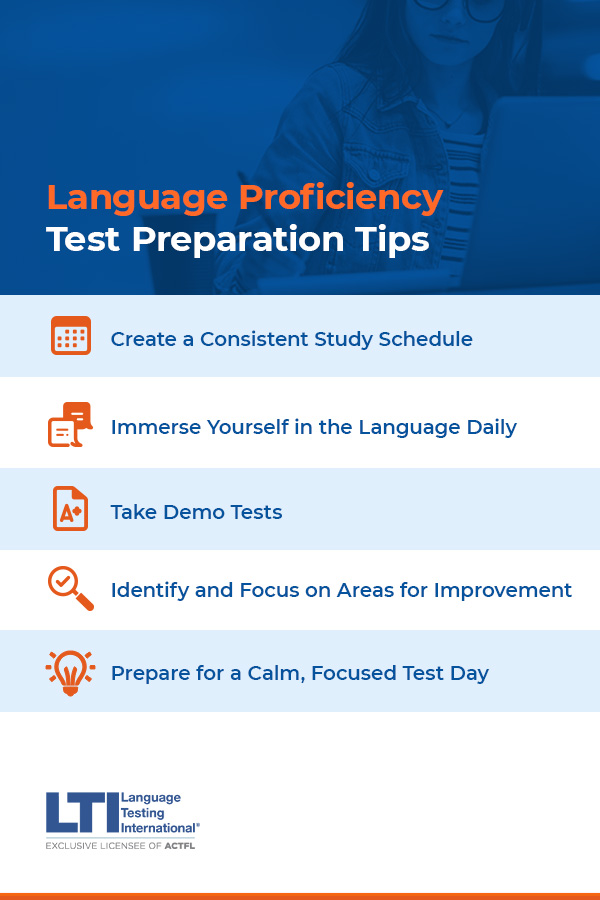
Create a Consistent Study Schedule
Proficiency develops over time, so it’s important to maintain a consistent study schedule. Consistent practice moves language skills from your short-term memory into your long-term, automatic recall. Daily exercises can help you speak, understand, and write spontaneously, which is what language assessments measure. Avoid cramming days or weeks before your test. Instead, set aside 15 minutes to an hour each day for at least a month.
It’s also important to set clear goals for yourself. Rather than saying you’re going to practice listening for half an hour, you can plan something specific, like listening to a podcast every evening.
Immerse Yourself in the Language Daily
Practical, everyday immersion helps you feel more familiar and comfortable using a language. Consider changing your phone’s language, as this exposes you to valuable vocabulary you use several times throughout the day. You can also watch your favorite movies and TV shows in your target language without subtitles. When you listen for context, you can train your ear to understand the language in its natural speed, intonation, and rhythm.
Language immersion is an effective learning technique because it provides high-volume, constant exposure. This strategy mimics the natural language acquisition process we experience as children, which accelerates retention.
Take Demo Tests
A demo test familiarizes you with test formats, so you know what to expect when you take your official assessment. The goal of a demo is to understand a test’s format, question types, and timing. Taking a demo test is an excellent way to build confidence as you prepare.
Identify and Focus on Areas for Improvement
Self-assessment is essential. Use your practice sessions to identify your areas for improvement. Which of the four language skills feels the most challenging? Are there certain sentence structures or words you need more practice remembering? Dedicate the majority of your study time to these areas until you feel more comfortable with them.
Prepare for a Calm, Focused Test Day
Get seven to eight hours of sleep the night before your assessment. Try to eat a healthy breakfast the morning of your test. It’s also helpful to log in online or arrive early so you can ensure good internet connectivity and start with a calm mindset. You can also try mindfulness practices and deep breathing to feel relaxed as you prepare for your test.
Avoid spending too much time on a challenging question. Skip and return to it at the end of the assessment (if possible) so you can focus on the prompts and questions you understand best. If you take an oral proficiency test, focus on answering each question to the best of your ability. You can potentially manage any stress or nervousness with deep breathing and positive visualization, mentally rehearsing a successful test experience.
What Not to Do
Proficiency test preparation also involves avoiding common pitfalls when preparing for and taking your language proficiency test. Memorizing rehearsed answers, prioritizing grammar over communication, and trying to cram information at the last minute can hinder your learning. These methods may seem productive in the moment, but they will likely not help you comprehend the language.
Understanding ACTFL Language Proficiency Levels
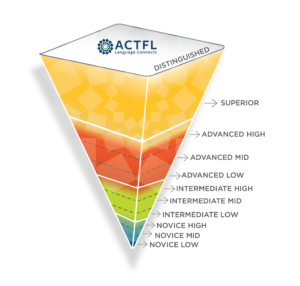
ACTFL® assessments place test takers’ demonstrated proficiency on a proficiency rating scale that ranges from Novice to Superior. Your test results will place your demonstrated proficiency in one of the following levels based on your communicative abilities:
Novice
At the Novice level, you communicate primarily through memorized words, phrases, and formulaic expressions. You may often rely on learned patterns rather than creating original language.
This level reflects an ability to ask and answer simple questions about highly familiar topics, such as your name, origin, or basic needs. Understanding at this level is often limited to keywords or predictable contexts. If you perform at this level, it means that you need more practice to manage unpredictable conversational situations. While your communication is understandable in limited circumstances, it requires frequent assistance from a speaker or listener who is accustomed to interacting with learners of the tested language.
This level is divided into the Novice Low, Novice Mid, and Novice High sublevels. The sublevel indicates the degree to which you demonstrate the characteristics/features of the major level.
Intermediate
If your assessment reveals that you are a language user at the intermediate level, this means that you can create with your target language. You can combine learned elements in new ways and form original sentences. This level also reveals that you can handle straightforward communicative tasks, initiating and sustaining simple conversations on personal topics, work, school, and leisure.
While you can ask and answer direct questions at this level, you may still require repetition or rephrasing from others. It’s also common to experience difficulty with complex or abstract ideas at the Intermediate proficiency level. You can manage routine social situations, but you might encounter challenges when you face unexpected complications. This level comprises the Intermediate Low, Intermediate Mid, and Intermediate High sublevels.
Advanced
Scoring at the Advanced language proficiency level means that you can participate in everyday conversations and routine work-related interactions with ease and confidence, handling a wide range of concrete, and possibly, some abstract topics. You can narrate and describe past, present, and future events.
As a language user at the Advanced level, you can manage most social situations and unexpected changes in conversation. To score at this proficiency level, you must demonstrate clear, organized communication. While some error patterns may persist in low-frequency language structures, others can generally understand the intent of your message without difficulty. This level encompasses the Advanced Low, Advanced Mid, and Advanced High sublevels.
Superior
The Superior level represents a highly sophisticated and effective use of the language. A language user at the Superior level can tailor language to different audiences and purposes, exhibiting a high degree of sociolinguistic and pragmatic competence. This proficiency level reflects that you can communicate with accuracy and effectiveness in a wide range of formal and informal settings. An ACTFL Superior language proficiency demonstrates a deep understanding of cultural nuances and implications.
To reach this level, you must be able to participate in complex arguments, provide detailed explanations, and deal with linguistically unfamiliar situations with ease. You must also showcase consistent, reliable performance across various topics and communication modes, demonstrating linguistic coherence.
Demonstrate Your Skills With a Trusted Assessment

Whether you need to prepare for an English proficiency test, prove your skills in German, or test your Spanish speaking ability, regular practice is vital. Now that you have a better idea how to prepare for a proficiency test, it’s time to take the next step toward certification. Language Testing International® delivers ACTFL language assessments to evaluate your language skills accurately. ACTFL assessments are trusted and widely recognized by organizations, businesses, and government agencies. Select a language to learn more about ACTFL tests and schedule an assessment.