Imagine that you’re in the middle of a conversation in your second language. You reach for a word you once knew instantly, maybe a common French verb or a simple Japanese greeting, and it won’t surface. You know it’s there somewhere. It just won’t come.
That gap is frustrating, especially after years of study or time spent living abroad. It doesn’t mean your effort was wasted, though. It’s a well-documented, normal cognitive process called language attrition, and it happens to language users everywhere, not just to you.
Understanding why this happens is the first step toward reversing it. This guide breaks down the science behind language attrition, offers practical strategies to maintain your language skills, and shows you how to get a clear picture of where your proficiency stands today.
What Is Language Attrition?
Language attrition is the natural, gradual decline of language proficiency that occurs when a language falls out of regular use over time. It isn’t the same as forgetting. According to research published in Frontiers in Human Neuroscience, attrition is best understood as a decline in retrievability, meaning the language becomes harder to retrieve even though the underlying knowledge doesn’t disappear entirely.
Think of it as a filing system. The brain prioritizes frequently used information, moving skills a person relies on less often from active recall into passive memory. Attrition can affect a person’s first language, too, though it shows up most often in a second or world language. Language attrition in bilinguals is especially common when one language begins to dominate daily life, pushing the other further into the background.
The Science Behind Language Attrition
Research shows a clear hierarchy in how attrition unfolds. Productive skills (speaking and writing) are significantly more vulnerable than receptive skills like listening and reading, a pattern that holds up consistently across second language acquisition research. Vocabulary is often the first place this shows up. Specifically, the words a person can actively recall and produce fade before the words they can still recognize when they see or hear them.
A 2025 study published in Frontiers in Psychology found that lexical attrition can happen quickly: among the 110 college students tracked over a single summer break, the attrition rate reached 52.7%. The same research identified attained proficiency as an important predictor of how fast that decline sets in. The more deeply a skill is built, the longer it tends to hold.
Progress doesn’t always move in a straight line, either. Proficiency can sometimes appear to dip when the brain is actually going through a U-shaped course of development, reorganizing new linguistic knowledge rather than losing old knowledge.
How to Maintain Your Language Skills
The best defense against attrition is active engagement built through consistent practice, not recreating a full classroom experience. Here’s how to prevent language attrition in sustainable, realistic ways:
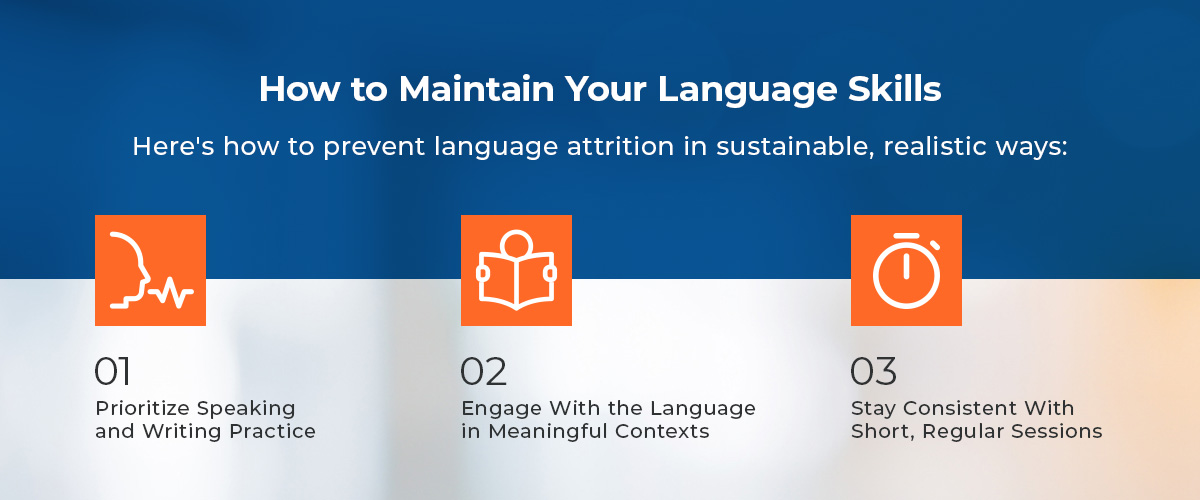
Prioritize Speaking and Writing Practice
Because speaking and writing skills fade fastest, they deserve the most intentional effort. Journaling, taking notes, or even writing a grocery list in the target language actively engages the retrieval system that attrition affects first. Speaking practice works the same way — a conversation with a language partner or a local exchange group keeps productive skills sharp. When those options aren’t available, recording voice notes or keeping a voice journal offers a workable substitute.
This kind of practice helps prevent a common frustration: understanding a language perfectly well but freezing when it’s time to actually speak it. Research on meaningful communication versus rote study found that real conversation preserves language skills more effectively than flashcards or drills practiced out of context.
Engage With the Language in Meaningful Contexts
Making a language part of everyday life works better than treating it as a separate study task. Receptive skills like listening and reading are more durable than productive ones, but they still benefit from regular use. Reexposing yourself in a natural context — consuming content you’d already enjoy just in your target language — is one of the most effective ways to reactivate implicit language knowledge.
Consuming podcasts, movies, and TV shows in the target language, without subtitles, keeps receptive skills active while training the ear to pick up natural speech patterns. The goal is to move beyond repetitive vocabulary drills toward applying the language in more complex situations, like reading industry news or discussing an abstract idea. Meaningful, communicative engagement consistently outperforms isolated drills.
Stay Consistent With Short, Regular Sessions
Frequency matters more than duration. Short, regular sessions spread across the week do more to preserve proficiency than infrequent, marathon study sessions or passive exposure alone. Short, regular periods of meaningful language engagement throughout the week can help keep retrieval active.
Small changes can support this habit. For example, someone who spent time immersed in German while living in Berlin or is a heritage speaker of Mandarin Chinese might switch their smartphone’s language settings to create low-effort touchpoints throughout the day.
The Importance of Consistency in Long-Term Language Retention
The real challenge is maintaining second language skills over years, not just weeks. Consistency is widely regarded as the single most important variable in long-term language retention. Frequent use of a language tends to slow attrition, while infrequent use tends to speed it up. Even moderate, regular use can lead to modest proficiency gains over time.
The benefits extend beyond the language itself. Bilinguals with higher proficiency levels scored significantly higher on tests measuring convergent and divergent thinking compared to bilinguals with lower proficiency. Understanding how to retain language skills, in other words, means treating a language as a living tool rather than a static achievement.
Proficiency also develops as a nonlinear continuum rather than a straight, upward-only line. Consistent language use can help reduce attrition and support long-term language maintenance more effectively than sporadic engagement. Still, even with steady practice, it’s worth periodically confirming where that proficiency actually stands. That’s where Language Testing International® comes in.
Verify Your Language Proficiency with ACTFL Assessments
Once you understand why attrition happens and how to build habits that counter it, the next step is getting a clear, objective read on where your language proficiency actually stands. ACTFL® proficiency assessments delivered by Language Testing International (LTI®) assess language proficiency based on a person’s ability to use language effectively in real-world, spontaneous contexts, regardless of how that language was acquired. Proficiency is rated on the ACTFL proficiency scale, from Novice through Superior, with Low, Mid, and High sublevels for the first three major levels.
As the exclusive licensee of ACTFL assessments since 1992, we deliver testing in more than 120 languages across over 60 countries. Taking a language proficiency assessment can provide a clearer picture of your current proficiency level and, when used appropriately over time, can help you understand changes in your language skills. Schedule your assessment today and put your maintenance efforts to the test.