Bilingual police officers are a critical asset to your law enforcement agency, particularly in communities where residents are less proficient in English. Police officers who understand the cultures of these residents and can effectively communicate with them allow non-English language users to feel safe and understood. They also enable law enforcement professionals to receive more accurate information about crimes.
This guide explores the demand for bilingualism in law enforcement in more detail and offers practical strategies for building rapport within the community.
Understanding the Demand for Bilingualism in Law Enforcement
The multilingual makeup of U.S. society is growing, increasing the need for law enforcement employees with world language proficiencies. Whether their interactions with citizens are friendly or to remind them of the law, effective communication and understanding can help officers connect with community members on a deeper level.
Communication barriers can create distrust and misunderstanding in the community and may even breed xenophobia. Bilingualism in law enforcement helps ensure that non-English-speaking communities feel safer and more confident in their police force and can comprehend situations as they happen.
Fortunately, the Office of Community Oriented Policing Services (COPS Office) developed a policy that ensures people with limited English proficiency, also called limited English proficient (LEP) people, have access to the assistance they need when they encounter a federally conducted program or activity.
A federally conducted program or activity involves law enforcement professionals engaging with the general public as part of an ongoing federal agency operation. It may also include a program or activity where LEP individuals are beneficiaries or participants in a federal agency’s direct service or benefit administration.
An agency is typically obligated to provide language-assisted services if a case meets the requirements in the four-factor analysis set by the COPS Office. This analysis depends on the number of LEP people an eligible law enforcement service encounters in an area, how frequently LEP individuals get involved with federally conducted programs, how beneficial or important the service or program is, and the resources available and their cost implications for the agency.

To influence bilingualism in law enforcement, police departments can partner with Language Testing International® (LTI), a leader in language proficiency testing for over 120 languages in more than 60 countries. Whether you’re looking to test candidates’ language skills or train and test current employees, LTI delivers ACTFL assessments to determine whether they have the language proficiency required to bridge the communication gap between different cultural identities.
The Importance of Communication Skills for Bilingual Officers
Some policing situations require immediate action, such as responding to emergencies and de-escalating potentially dangerous situations. Having bilingual officers can help ensure they quickly evaluate and understand the circumstances. They can also easily ask questions, understand community members, and communicate legal rights and responsibilities. These tasks require advanced communication skills, allowing officers to perform their daily duties in other languages.
Effective policing also involves educating the community while building trusting relationships. Officers should address participants at an incident in a way that reduces tension. Proficiency in other languages can help law enforcement collaborate with the community when investigating criminal activity and take accurate testimony while speaking with witnesses, victims, or their relatives. Departments may want to enroll employees in tailored police officer training programs, which can teach officers cultural sensitivity and the language skills needed to work with diverse communities.
Implementing Community Policing Strategies in Multilingual Communities
According to a study about diversity in policing published by Science in 2021, Hispanic and Black police officers and female officers in Chicago use less force and make fewer stops and arrests than white male officers do. Encouraging positive interactions and experiences for the community in this way requires a deeper understanding of particular locations.
One effective community policing strategy includes collecting data about the demographics of communities, residents’ characteristics, and prominent languages in the area. After gaining this information, departments can recruit and deploy bilingual staff and allocate resources accordingly.
Law enforcement agencies can also establish language access protocols and policies for interacting with LEP people. Departments can also coordinate with one another to share resources and create improved communication approaches for LEP residents.
Benefits and Challenges of Bilingual Policing
Bilingual police officers help foster more inclusive environments by building trust and rapport within the community. When residents feel they can trust their local police, they may be more likely to come forward about crimes in the area and more willing to share information that may be critical to investigations. Having bilingual units with officers who speak their language and understand their culture helps build trust. Bilingual policing also creates increased job satisfaction and retention rates because the work environment allows all officers to feel welcomed and appreciated.
One of the challenges is that there may be a limited number of qualified bilingual candidates. In some multilingual cities, some residents may be non-English language users or know their native language more than English. Others may be fluent in English and only know the basics of another world language, decreasing their likelihood of communicating effectively during high-stress situations.
The Path Forward: Training and Testing for Bilingual Law Enforcement Professionals
Despite the challenge of finding well-suited bilingual candidates, current law enforcement professionals and new recruits can undergo training and testing to enhance or evaluate their language capabilities.
Start by creating and implementing language training programs. Use these educational programs to teach law enforcement professionals cultural communication skills, essential terms, and best practices to remember. You can also encourage these individuals to practice independently to improve how they deliver commands and have necessary conversations with community members.
Remember that employees have varying language skills. Testing current employees and potential candidates with language proficiency assessments measures an individual’s ability to use a particular language regardless of how they acquired it.
As the exclusive licensee of ACTFL assessments, LTI delivers proficiency tests in speaking, listening, writing, and reading. The ACTFL scale rates proficiency in four main levels — Novice, Intermediate, Advanced, and Superior. Each main level is further divided into Low, Mid, and High sublevels to help determine whether a person has the proficiency required for effective communication.
Get Language Proficiency Testing for Law Enforcement Employees With LTI
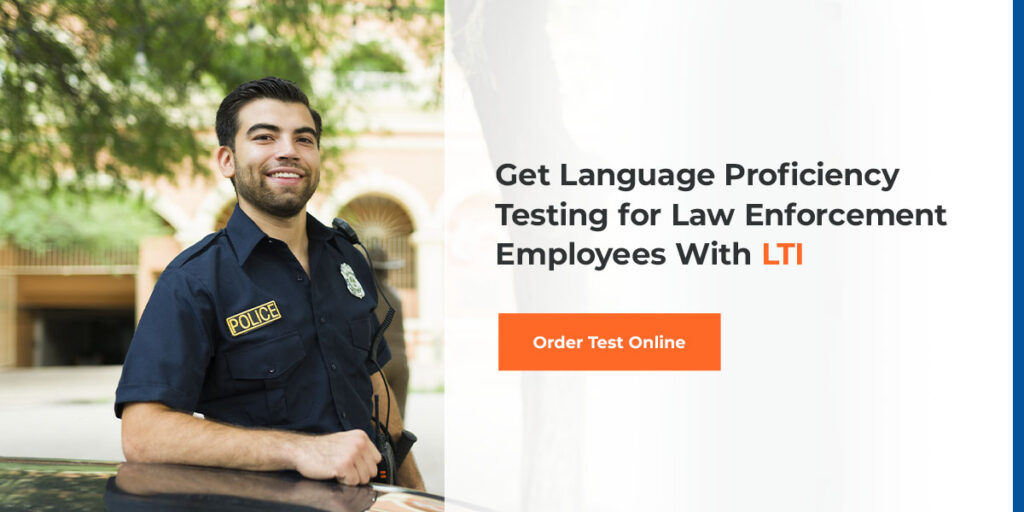
Bilingual law enforcement employees can help community residents feel safe and secure while relying on police officers. A bilingual program can also retain diverse employees. LTI has delivered language assessments to government and federal agencies since 1998 to measure candidate and employee language proficiency, making it a reliable and effective way to assess your employees’ abilities.
Our professionals will speak with you to identify your unique needs and deliver language assessments that accurately reflect those needs. To start building bilingualism in law enforcement, request a quote with LTI today.