Have you ever wondered how you can integrate the information in the ACTFL Proficiency Guidelines – 2024 (Guidelines) and the ACTFL Performance Descriptors into your Dual Language Education (DLE) or Dual Language Immersion (DLI) curriculum? Are you trying to meet DLE standards and also want to ensure you’re targeting performance descriptors at specific language proficiency levels?
Start with the End in Mind
Consider mapping out the standards you are targeting in a lesson or unit. Based on the theory of backward design (Wiggins & McTighe, 2005), start with the end in mind.
- What is the desired output or evidence of learning you want from your students?
- From there, consider what learning outcomes will help you achieve that target.
- Finally, build the learning activities and assessments that will guide your students along the path to the desired outcomes.
If you are working to align your program with the Guidelines and a proficiency focus generally, keep that alignment across the board – in your learning objectives, assessments (e.g., ACTFL Assessment of Performance toward Proficiency in Languages, or AAPPL), learning activities, professional development, etc.
As you do this planning, consider what modes of communication will be part of your learning activities. Here’s a sample scope and sequence that could be for a grade 9 DLE/DLI Language Arts class, illustrating how NCSSFL/ACTFL can-do statements and related performance tasks align DLE standards.
Example: Language Arts (L1 & L2)
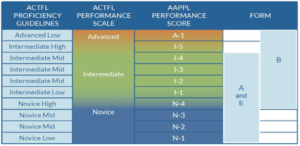
Evidence of Learning: AAPPL score of I-2 to I-4 (Intermediate Mid)
ACTFL Modes: Interpersonal, Interpretive, Presentational
Standards Alignment: Biliteracy development, use of authentic texts, cross-linguistic connections.
|
Thematic Unit |
Sample Can-Do Statements (L1 & L2) |
Performance Tasks |
| First quarter: Identity & Community |
I can describe myself and my family. I can talk about very familiar things in my community. |
Write several sentences about yourself in both languages. Present a basic bilingual community map. |
| Second quarter:
Heroes & Role Models |
I can describe someone I admire. I can explain in simple sentences what they did. |
Create a bilingual biography poster and discuss it with your partner. |
| Third quarter:
Cultural Stories & Legends |
I can retell a short story. I can compare main ideas from two legends or folktales. |
Compare simple folktales from each culture in both languages. |
| Fourth quarter:
Our Changing World (Environment & Society) |
I can summarize short articles.
I can share basic opinions and advice on a variety of familiar topics. |
Write and present a short persuasive speech in both languages. |
Targeted Outcomes and Content Alignment Make Powerful Programs
In this example, Intermediate Mid is the desired goal. As the school year advances, the can-do statements begin to include Advanced can-do statements. By using both Intermediate and Advanced can-do statements, students practice and work to develop language at a higher level (and then are assessed at the Intermediate level).
With evidence of learning defined and a targeted scope and sequence, the process of building learning activities and selecting assessments becomes much more focused. And with both Guidelines and DLE Guiding Principles in mind, you ensure that your immersion program is developing both content and language mastery in your learners. ACTFL assessments, such as the AAPPL, can improve your assessment strategies by using content that is age- and proficiency-level appropriate and tightly aligned to the Guidelines. Detailed AAPPL reporting can help you identify specific skills where learners may need more support or practice. Language Testing International (LTI), the exclusive licensee of ACTFL, provides robust AAPPL reporting features and a dedicated support staff to help you digest test data and identify actionable steps based on that data.
Further, ACTFL’s Educator Resources, professional learning opportunities, and publications can help you identify realistic language goals in your DLE/DLI programs. With a proficiency focus in your DLI/DLE programs, students will develop language competency beyond just content vocabulary and will be better positioned to leverage their language skills in real-world contexts.