 In 1992, Language Testing International (LTI) was founded as a way to bring reliable proficiency testing to a wider audience, and so began our close partnership with the American Council on the Teaching of Foreign Languages (ACTFL). Twenty-five years and almost three million assessments later, LTI is still proud to be the official testing office of ACTFL and the sole licensee of their assessments. Our goal remains the same – deliver valid and reliable language proficiency tests to the public – and here is how we have responded to the changing needs of our customers; expanded list of languages, remote proctoring services, task analysis and customization services. These days we do it at a scale and in ways facilitated by computer adapted technology and remote proctoring when appropriate, in markets such as K-12, Higher Education, Fortune 500 companies, state and local municipalities and the federal government. We couldn’t have imagined twenty-five years ago that we would be delivering over six hundred thousand tests annually!
Continue reading
Four Critical Questions To Ask When Choosing a Selection Test
 Pre-employment selection tests can be valuable tools, providing vital information about candidates’ applicable knowledge, skills, and abilities before they are offered employment. Ideally, this information will save you time and money by increasing the likelihood that candidates will perform well and stay on the job. To reap these rewards, however, you must carefully weigh your assessment options and choose wisely. Asking the following critical questions is key to identifying a test that will help you select and keep the right people.
ACTFL’s Martha G. Abbott Appointed to National Security Education Board

ALEXANDRIA, VA — ACTFL Executive Director Martha G. Abbott has been appointed by President Barack Obama to the National Security Education Board.
“It is truly an honor to be appointed by the President to serve in this capacity on the National Security Education Board advising on the important work of building our nation’s linguistic and cultural capacity,” Abbott said.
“We are delighted to have Marty represent ACTFL and the language education community on the National Security Education Board,” ACTFL President Peter Swanson added. “Her appointment sends a strong message about the importance of global competence in the 21st century.”
In a press release Sept. 7, President Obama praised Abbott and H.T. Nguyen, who was appointed to the National Council on Federal Labor-Management Relations.
Continue reading
Does Bilingualism in America Threaten the English Language?
 English is in no danger of disappearing any time soon; it is firmly established both in America and in countries throughout the world. In fact, no language has ever held as strong a position in the world as English does today. Some people worry when they see Spanish showing up on billboards and pay phones, but in a neighborhood with a high Spanish- speaking population, it makes perfectly good sense for public information and instructions to be printed in both English and Spanish. This doesn’t mean that the English language is in danger.
The truth is that there will probably always be immigrants in the U.S., coming from a wide variety of countries, who cannot speak English but whose grandchildren and great-grandchildren will end up being native English speakers. The reason for this is, again, the fact that it is much easier for children to learn another language than it is for adults. Adults who immigrate to the U.S., especially later in life, may never really become fluent in English. It’s not that they don’t want to speak English; it’s simply much more difficult for them to learn it well. Their children, however, will be able to pick up English easily from their friends and the society around them.
Continue reading
Is Texting Killing the English Language?
 Texting has long been accused as being the downfall of the written word, “penmanship for illiterates,” as one critic called it. To which the likely response is LOL. Proper testing is not writing at all — it’s actually more like the spoken language. It’s a “spoken” language that is evolving and becoming more complex as time passes.
But let’s go back a while. Writing was invented over 5,00 years ago, and language likely traces back perhaps 80,000 years. So talking came first; writing is just an artifice that came along much later. Due to this, writing was first based on the way people talk, with short sentences — think of the Old Testament. However, while talking is largely subconscious and rapid, writing is slower and more deliberate.
Continue reading
Latest Anti-Discrimination Rules: Language Assistance for Non-English Speakers
 On May 18, 2016, United States Department of Health and Human Services (HHS) published its final rules implementing new anti-discrimination rules for Non-English Speakers within provisions of the Affordable Care Act § 1557. This is the first of several alerts discussing aspects of the new rule. The alert focuses on those provisions requiring language assistance for persons with limited English proficiency; future alerts will cover rules related to sex discrimination and persons with disabilities. The new language assistance rules build on but extend beyond HHS’s 2003 Guidance Regarding Limited English Proficient Persons.
Continue reading
ACTFL Establishes Center for Assessment, Research & Development
ALEXANDRIA, VA – The American Council on the Teaching of Foreign Languages (ACTFL) announces the establishment of the ACTFL Center for Assessment, Research and Development. The ACTFL Board of Directors approved the proposal for the Center during its May 13-15 annual meeting.
The mission of the Center is to support PK-12 schools and institutions of higher education in areas of assessment and articulation; to develop and maintain high-quality language proficiency assessments; to train, certify and maintain highly reliable testers and raters; to conduct research on proficiency and performance outcomes; and to collaborate with other language organizations and government agencies to support and promote research in the areas of high quality language teaching and learning, including examining implications for teacher education.
Continue reading
The OPIc Arrives in China
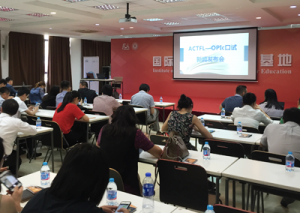 The Oral Proficiency Interview computer system (OPIc), developed by the American Council on the Teaching of Foreign Languages (ACTFL), was recently introduced in Shanghai to assist those seeking employment with international companies to demonstrate their proficiency. Currently, the OPIc covers 13 languages and five of them, English, Russian, Japanese, Korean and Spanish, are now available in China.
“The system was introduced in China because it contains evaluation tests for multiple languages, rather than a single language like other tests,” said Li Peize, President of the Beijing-based Chinese Testing International of the Confucius Institute. “It was designed by more than 10,000 language experts around the world.”
Continue reading
Visit LTI @ SHRM (April 18-20) Booth # 308
 Visit LTI at Booth # 308 in Florida during the SHRM Talent Management Conference & Exhibition – 4/18-20. While here, take a spin at our Prize Wheel where you can win gift cards, free tests and much more! Speak with one of Language Testing professionals and learn how we work with the HR community to ensure the best hires.
The SHRM 2016 Talent Management Conference & Exposition gives you the tools, resources, innovations and solutions you need to evolve your human capital strategies. The conference provides ideas to advance you personally and professionally, while boosting your talent management strategies. More than a thousand HR professionals will join us in Orlando April 18-20, 2016—this is an excellent opportunity to make new connections, network with old friends and expand your list of contacts.
Visit LTI @ the TESOL Expo (April 5-8) – Booth #633
 Language Testing International is excited to once again participate and exhibit at TESOL this year. For those of you attending, be sure to stop by the LTI booth (#633) and speak to one of our Language Testing professionals.
And don’t forget to take a spin at our “PRIZE WHEEL” where everyone is guaranteed to win!
We also urge you to attend our informative Workshop Sessions on Wednesday, April 6th. See below for more details.
- Wednesday, April 6th @ 2pm – Room #323 – “ACTFL Testing Proficiency Performance/K12 & Higher Education.” Presented by Brett Laquercia.
- Wednesday, April 6th @ 3PM – Holiday #1 – “Empowering Language Learners by Developing and Recognizing 21st Century Literacies” – (Sponsored by ACTFL) Presented by: Marty Abbott.
To learn more about TESOL or to view the Expo schedule click here!