The Benefits of Pre-Employment Language Testing for Law Firms & Corporate Legal Departments
 Introduction
Attorneys know that Rule 1.1 of the American Bar Association Model Rules of Professional Conduct “ABA Models Rules,” which has been adopted by most states, requires that attorneys “shall provide competent representation to a client. Competent representation requires the legal knowledge, skill, thoroughness and preparation reasonably necessary for the representation.”
So what happens when a potential client who doesn’t speak English requests the services of that attorney? This scenario is becoming increasingly common. The United States is generally becoming a more diverse country, and the number of cities and counties with minority-majority populations is growing. In cities like New York, Chicago, Los Angeles, Miami, and others one can hear numerous languages spoken in the streets. This also means that many individuals who may need legal assistance may not be able to communicate in English. How does an attorney provide competent representation if the attorney and client do not communicate in the same language?
While most of us can recall a funny “lost in translation” moment, the legal implications of mistranslations is not a laughing matter. Attorneys know that use of language and word choice matters, and can make or break a case for a client. This is also true when the language is not English.
First, it is important to note there is a legal distinction between “interpreting” and “translating.” The United States Supreme Court held in Taniguchi v. Kan Pacific Saipan, Ltd. that “the word interpreter applies only to those who translate orally” while “the words translate, translations, translator are used when the immediate result of the work is a written text.”
There are two ways to address the language issue. The first is to hire attorneys and staff who speak foreign languages. The second is utilize the services of professional interpreting and translating services. The key question that applies to each of these options is how does an attorney confirm that the people who claim to be fluent in the language are actually capable of competent interpreting and translating?
Is your organization taking shortcuts in determining the proficiency level of your multilingual job candidates and professional language service providers?
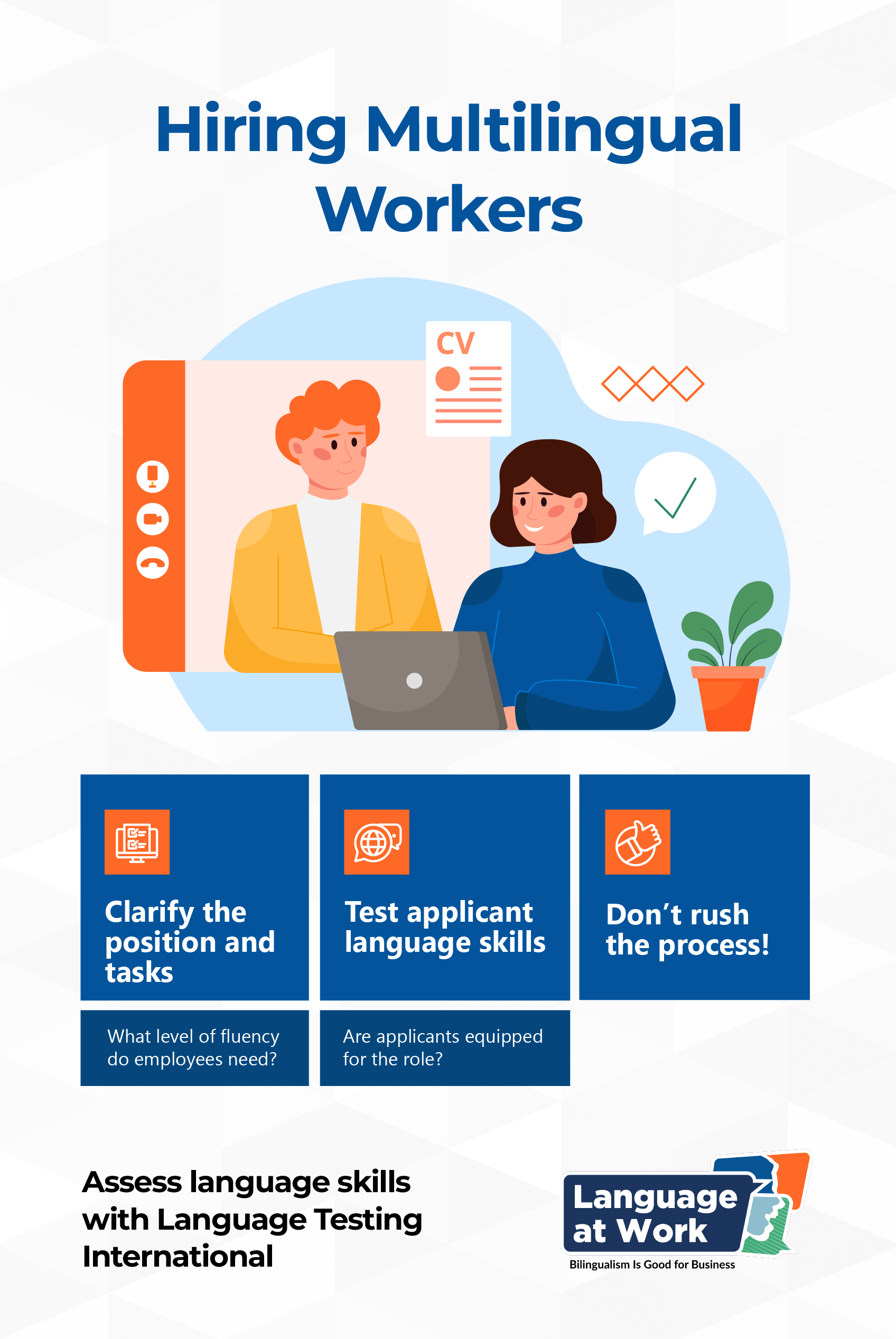
For many companies, hiring and outsourcing are long and difficult processes. It requires a lot of resources —both in time and money— to find the right person who will not only fit the job’s requirements but will also fit with your existing team. Thus, how can you make your hiring and outsourcing process more effective and efficient, and at the same time not take short-cuts to ensure that the people or professional language services you hire truly have the language skills showcased on their resumes?
Taking shortcuts like using Google Translate will not be enough, and as anyone who speaks multiple languages can tell you, it is prone to mistranslations. ABA Model Rule 1.4 requires that Attorneys communicate relevant information to their clients. Also ABA Model Rule 5.3 imposes certain responsibilities upon law firms and associations for the non-lawyer services that they employ. The New Hampshire Bar Association Ethics Committee issued an advisory opinion regarding this rule stating that “When the attorney cannot communicate directly and fluently with the client in a language that the client can understand… the attorney must make use of the services of a qualified, impartial interpreter. Ideally, the attorney would accomplish this by associating with a bilingual attorney, working with a bilingual employee or staff member who can interpret communications between the attorney and client, or utilizing a commercial or community interpreter service.”
Case law can show us how even the mistranslation of one word can lead to significant loss. Willie Ramirez was rushed to a Florida hospital after falling unconscious. Mr. Ramirez didn’t speak English and wasn’t properly treated due to the mistranslation of the word “intoxicado.” As a result, Mr. Ramirez suffered brain damage, was left quadriplegic, and reached a settlement with the hospital for $71 million dollars.
Here is why using legally defensible assessments is so crucial to your organization.
To reduce the risks of costly “lost in translation” moments that can compromise the rights of your client, seek staff and professional services who are certified with a legally defensible language assessment. Such assessments should be constructed to be reliable, accurate, and fair. The questions should be well written and appropriate, prompts are delivered in a secure environment, and responses scored using best practices and well-respected standards. The assessments measure, as accurately as possible, a participant’s “true” language ability or performance level to accomplish specific tasks.
Standardized pre-employment language certification is one of the most effective ways to simplify yet add the appropriate rigor to the hiring process—provided that it’s done properly. Unfortunately, not all pre-employment language certifications are made equally. Some are excellent tools for helping you choose candidates and professional services, while others fall flat—and could even leave your firm or organization in a precarious legal situation as mentioned above.
Legal challenges may come from individuals or groups who claim the organization itself, the processes followed (e.g., administration, scoring, setting passing scores) or the outcomes of the testing (i.e., whether a person is certified) are not legally valid. Essentially, the legal defensibility has to do with the question, “Are the assessment results, and more generally the testing program, defensible in a court of law?” In the event that a firm or organization faces a language-related lawsuit, it needs to rely on the certifying organization being able to withstand legal challenges.
There are four main areas where language certifications need to prove their value: reliability, validity, fairness, and cut scores. Each of these areas requires consideration when developing, administering, and reporting (conducting research) on assessment results. Language testing is a high-stakes test, which means it is critical to meet these requirements.
Cheating on tests and breaches of security are areas of concern that throw into question the validity of assessment results. If assessment results cannot be trusted to be an accurate reflection of a participant’s “true” ability or performance level, then the validity of results is questionable and the legal defensibility of the assessment program may be in jeopardy. Security is important in ensuring legal defensibility. Defensibility requires vigilance both in terms of process and information use.
Organizations offering legally defensible language certifications assemble and maintain a defensibility evidence portfolio that shows how they have adhered to best practices and documented their processes and procedures.
How do you know if a pre-employment test makes the grade?
Here are some best practices to help guide you based on the EEOC Employment Test and Selection Procedure Fact Sheet.
1) Pre-employment assessments and procedures must be valid, job-related, and appropriate for the employer’s purposes.
Employment testing is perfectly legal, provided that it meets a few requirements. The test must be valid, reliable, and grounded in research by subject matter experts. That doesn’t just mean having professional question writers. Psychometric guidelines need to be followed, along with certain standardized processes inherent to written or online tests.
2) Pre-employment tests cannot in any way discriminate against a group based on race, color, national origin, sex, religion, or protected disability.
U.S. law very clearly prohibits discrimination against anyone on the basis of these protected classes. That means a pre-employment exam that’s within the law must be designed to offer all potential employees an equal chance to display their knowledge, independent of their background.
3) Pre-employment tests must be consistently updated to ensure that the above factors remain true.
Pre-employment tests should constantly evolve to provide the best measure of assessments. Ongoing test research and development provides a valid and reliable testing instrument.
Language Testing International (LTI) offers pre-employment language tests that determine the proficiency level of a multilingual person. Assessments are available for speaking, reading, writing, and listening. Our tests don’t just simplify the hiring process for your organization—they are also legally defensible. To learn more about LTI and speak to a language testing specialist contact us today!

 The Importance of Communication in Light of the Coronavirus Outbreak
 Certified Language Skills: A Pathway to Foreign Language Incentive Pay (FLIP)



 We are living in a global society; there is explosive growth nationally and internationally. Our clients, prospects, and staff are diverse, yet
 My experiences at the annual ACTFL convention are always a little different from a “typical” ACTFL attendee. Given my district role as a program supervisor, I am fortunate to start ACTFL Week on Tuesday, when the National Association of District Supervisors for Foreign Language (NADSFL) convenes for its annual meeting. By the time ACTFL convention rolls around, my brain is full and I have to recharge quickly so I can focus on interesting and timely presentations. This year was no different.