Be More Than an Insurance Agent—Be an Agent of Change!

insurance agent talking to a young couple

Handling insurance details, claims, and sensitive and delicate information where emotions are involved can be a difficult task even when the policyholder and the insurance agent speak the same language. Can you imagine how challenging it can be when we add a language barrier into the mix? The insurance industry is aware of the need to recruit employees with adequate language proficiency levels to meet the diverse needs of customers today. If you are a bilingual or multilingual professional and your intention is to pursue a career in the growing and constantly evolving insurance industry, you should know that both employers and customers need you.

As stated by a survey conducted by Ipsos Public Affairs for ACTFL, most employers point out that the demand for languages other than English has grown over the past five years. Additionally, the ability to speak more than one language has become one of the top skills required in the delivery of different services, including insurance offerings. Establishing a connection between language skills and economic competitiveness is just one of the main results of this survey, which strives to raise awareness and action around the establishment of language competency in the United States, as specified in the report.

According to the Insurance Information Institute, the insurance industry is currently transforming to encourage and boost diversity in their organizational culture. A multilingual or bilingual insurance agent is a valuable resource that can make recommendations based on the specific needs of the community he/she works for or represents. Similarly, their commitment and meaningful participation in the community they serve is a vital piece of creating powerful relationships and gaining the trust of prospective clients. An article featured in AgentPipeline.com highlights that, “A more significant piece of what insurance agents do is educate our customers on how to ensure they are covered and help protect their financial security and teach them how to take advantage of benefits that are included in their insurance policies.” To become active in your community, they recommend volunteering at community events, supporting local businesses, and developing professional connections online with digital tools, as well as other activities.

Watch –> Leading with Understanding: Bilingual Insurance Agents Build Strong Working Relationships

One of the main goals of the insurance industry is to provide quality services. The insurance world recognizes that hiring professionals who can speak more than one language is an advantage that helps impart exceptional customer service that focuses on individuals’ preferred language. Communicating in an accurate way and overcoming language and cultural barriers can help build relationships, not just locally but internationally.

Helping customers understand what an insurance policy has to offer, especially those whose first language isn’t English, does create more business opportunities; however, and more importantly, it allows agents to make an impact in the lives of those they serve.

Contact Language Testing International (LTI) if you need to get certified in another language and provide your current or future employer and your customers with reliable and legally defensible language proficiency results. The validity of each assessment is supported by three decades of research. LTI makes the process simple with remotely proctored assessments in over 120 languages that you can take anytime, anywhere.

How to Highlight Your Language Skills to Get Noticed

close up of person holding a resume

If you are proficient in more than one language, you possess a highly marketable skill. Do you know which languages are most marketable? According to Preply, the three most frequently requested languages in job postings are Spanish, Chinese (Mandarin and Cantonese), and French.

Consider this: As of May 15, 2022, Indeed has posted over 900 jobs in the U.S. with the keywords multilingual speaker. Just over a year ago, Indeed also posted an article on the 13 Best Careers for Multilingual Professionals.

Certify Your Language Skills Here

Learning another language is a skill that requires dedication and commitment. In addition, those who are bilingual and multilingual are known to be better multitaskers and problem solvers—qualities you want to make known while job hunting.

Achieving a level of expertise in another language is impressive and should definitely be highlighted even if you’re not looking for a job where a second language is required.

Here are three suggestions for how to highlight and showcase your language skills to get noticed.

Make your language skills visible everywhere

Your resume is the first place where you should put your language skills. To make sure that these special skills are noticed, consider including them both in the skills section and the summary. As recruiters often only skim resumes, including your language skills on top of your resume will increase your chances of getting noticed. LinkedIn is another place where you should highlight your language skills. If a job application process also requires a cover letter, be sure you mention your language skills in there, too. Many companies are looking to expand globally in the near future, so even if language skills aren’t required for the job, being proficient will certainly make you a stronger candidate.

Be clear about your language proficiency

Many candidates include phrases such as “Fluent in . . .,” “Conversant in . . .”, or “Working knowledge of . . .” on resumes. Language fluency is hard to gauge, and your perception of your proficiency might not match what your true proficiency is when measured with a language proficiency assessment. It’s easy to overstate one’s proficiency. A recent survey has shown that nearly 60% of job applicants overstate their abilities on their resumes, including their language proficiency.

If you possess language skills, consider obtaining an official language proficiency certificate by taking a language assessment, such as the ACTFL language proficiency tests. An ACTFL test not only tells you exactly what your proficiency level is, but it also comes with an official certification that lets your prospective employer know exactly how well you can communicate in another language. The ACTFL assessments also come with digital badges issued by Credly, which makes showcasing your language skills on your resume and professional networking sites easier.

Be specific with your examples

Have you used your language skills in professional settings before? Talk about it! Instead of simply stating that you command another language, give specific examples of how you used them. Having a few concrete examples of how you incorporated your language skills into your work shows the hiring manager a level of ability in addition to just showing them your proficiency level. Another idea: post videos of yourself speaking or presenting in another language on your professional network such as LinkedIn. Recruiters searching for candidates will immediately notice them… and your language skills, too!

You might be proficient, but be prepared for a test

According to a recent ACTFL report titled, “Making Languages Our Business: Addressing Foreign Language Demands Among U.S. Employers,” 9 out 10 employers rely on language skills other than English to conduct their business, and this demand is expected to increase by 56% in the next 5 years. Client- and community-facing departments, such as Customer Services, Sales, Marketing, Management, and IT have the greatest need. Therefore, employers who rely on bilingual and multilingual employees need to have a reliable and validated method of checking job candidates’ language abilities. Validated and certified language proficiency testing offers an accurate measurement of language level, so more and more employers include language assessment as part of their recruitment process. If you haven’t taken a language proficiency assessment and don’t have a language proficiency certificate, you might be asked to sit for a test as part of your interview process.

Want to get certified? You can start here.

An Incentive to Stay: Employer-Sponsored Education and Certifications

collage of portraits of diverse group of people

In today’s hiring environment it’s very difficult to compete…as an employer. The unemployment rate is at an all-time low, and the lived experiences of working-class adults in the U.S. during the pandemic made many reconsider what they valued (or not) about their workplace culture.  Employers across all industries are now challenged with mitigating the demands for mindfulness, empathy, and creating a sense of purpose for their employees. Loyalty and staff retention is tied to the experience new hires have during the talent acquisition process, onboarding, and in their day-to-day circumstances at work. They want to find value in the work they are performing and feel that their employers care about them.

Recognizing the contributions of people while they are in the workplace and providing enrichment opportunities through training and employer-sponsored education are easy ways to boost morale and elevate the skills of your employees. Employers have always been able to facilitate these growth opportunities. Upskilling internal teams can ignite more productivity. It also helps build an organizational culture that seeks to invest in improving people to grow business not only in the U.S., but globally. It’s part of humanizing how we do business moving forward.

One often-missed business opportunity is tapping into an ever-growing pool of multicultural and multilingual professionals that are part of the U.S. workforce. According to the U.S. Bureau of Labor Statistics (BLS), in 2020 one in every three adults in the U.S. workforce identifies as being part of a non-White ethnic or cultural group, and these diverse communities are not monolithic. The Black community can have representation from people who identify as African American, Caribbean, and African. As for people of Asian descent participating in the U.S. workforce, the demographic make-up is comprised of people who identify as Asian Indian, Chinese, Filipino, Vietnamese, Korean, Japanese, Pakistani, Cambodian, Hmong, and others. People of Hispanic or Latino ethnicity can be of any race and represent 18 percent of the total labor force. This poses diversity in thought, approach, perspectives, innovation, and skills such as bilingualism or multilingualism. It also reflects diversity in new or repeat customers.

Many companies have adopted education coverage as a formal way to engage with their employees and helping them earn degrees that can be beneficial for business growth and expansion into global markets. For example, JetBlue Global Scholars Program offers the airline’s crewmembers the opportunity to earn a fully accredited associate or bachelor’s degree that includes major cost coverage, required licenses, certifications, transfer course credits, as well as job experiences and JetBlue training.

JetBlue also allows its multilingual employees to earn college credits by demonstrating proficiency in other known languages. JetBlue employees can take ACTFL language proficiency assessments in speaking, writing, listening, and reading and receive an official ACTFL language proficiency certificate for each test. Five of ACTFL assessments, which are conducted by Language Testing International, are recognized by the American Council on Education (ACE) for college credit. This affords bilingual or multilingual JetBlue crewmembers the chance to earn as many as 12 college credits per assessment, advancing their education and work opportunities as well. Many graduates are promoted to assume new roles within the company or qualify for more flight routes as a direct result of their language certification and their degree, thanks to the JetBlue Global Scholars Program.

Read more –> Business Benefits of Multilingualism

As word gets around among job seekers and workers looking for better employment opportunities where they will be incentivized for the skills they bring to the table – including proficiency in other languages – employers are pressed to identify, cultivate,

and provide opportunities for higher education and/or certification to their employees. They, in turn, will benefit from increasing employee satisfaction and loyalty, recognition as a mindful and supportive employer, and broadening of their market share by reaching multicultural customers using the language proficiency of their team.

Are you interested in language proficiency assessment as part of your employer-sponsored education opportunities? Learn more here and contact us to get started.

Listen to the podcast “Supporting Crewmembers Career Advancement with Languages” about how JetBlue is leveraging LTI’s Language Proficiency Testing to help the company’s employees further their academic and career advancement by offering the airline’s crewmembers the opportunity to earn a fully accredited Associate or Bachelor’s degree. Listen here.

We did the test. Now what? Part 1: Looking at yearly performance over time

two teenage girls doing school work

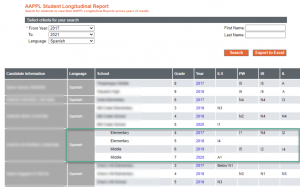
We love to use the AAPPL test for our students to earn the Seal of Biliteracy, but to refine our program and to recognize growth as well as achievement, we have explored the data reporting tools that the LTI Client Site has to offer. In this article, I will discuss a few of the ways that you can use this data as evidence to differentiate instruction, change curricular focus, and even to supplement your teacher evaluation rating. While some of the data analysis can be done directly within the LTI Client Site, you can also export student data to do a deeper dive using a spreadsheet.

One of the key ways that you can use the data is for longitudinal comparison of your students’ performance versus their own prior performance; you can also look at performance in your current year and previous years. Below I will demonstrate a few examples of how you can do this, as well as a breakdown of what our thought process around this information has looked like for our district specifically.

Refine Your Year Over Year Performance

For this example, I will produce tables for each of the four years that we have given the Spanish-language AAPPL, with a comparison of juniors and seniors. (We test during Seal of Biliteracy eligibility, which in Ohio is within 15 months of graduation.) Then I will repeat this for myself as a teacher and compare my students’ results to our school’s overall results.

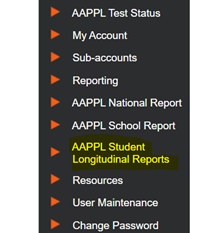
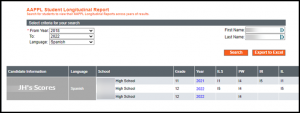
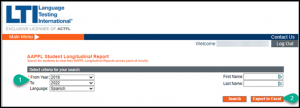
  1. From the Main Menu, click AAPPL School Report.
  2. Select your date range, Language, Teacher, and
  3.  the value that you wish to Compare By followed by your selected parameters.
  4. Click Apply Filters to see your data.

using the Client Site

Digging in: Performance by Grade Over Years

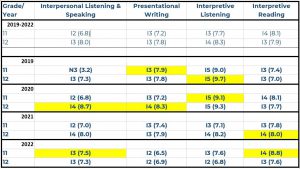
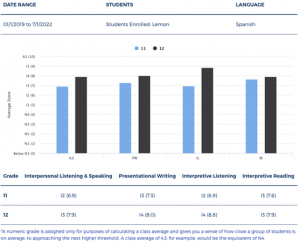
Taking the filters I just set, I’ll first look at performance by grade, starting in 2019. The following images show AAPPL Data for Spanish students in grades 11 and 12 by year, starting in 2019.

Spanish Students: Performance by Grade 2019
Figure 1. Spanish Students: Performance by Grade 2019

In Figure 1, you can see that the 11th and 12th graders are hovering in the intermediate range, with the exception of the ILS where the 11th graders had a notably lower average rating.

Spanish Students: Performance by Grade 2020
Figure 2. Spanish Students: Performance by Grade 2020

A year later, in 2020 (Figure 2), I see that the grade 11 students are achieving a higher average rating on the ILS than the previous year, now nearing I3 instead of N3. I also see that, overall, both 11th and 12th graders are achieving higher ratings than the previous year.

Spanish Students: Performance by Grade 2021
Figure 3. Spanish Students: Performance by Grade 2021

In 2021 (Figure 3), I can see lower average scores across the board and can consider what was different in this academic year from previous years.

Figure 4. Spanish Students: Performance by Grade 2022 (to date; some tests are still in progress)

I again see evidence of lower average scores across the board in 2022 (Figure 4).

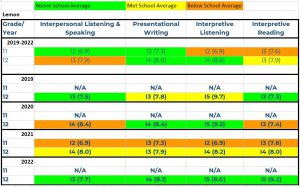
Spanish Students: Performance by Grade (Combined 2019-2022)
Figure 5. Spanish Students: Performance by Grade (Combined 2019-2022)

Figure 5 shows combined scores for all three years and allows me to get an overall snapshot of my 11th and 12 grade students over a period of time. I can compare this combined score over 3 years to any individual year, and I’ve now created my own norm-referenced internal benchmark.

This simple example of looking at students by grade over a series of years gives a glimpse into how useful longitudinal reporting can be. In my next post, I’ll dig into some analysis as I do a year over year comparison using the longitudinal data.

The Insurance Industry Welcomes Your Fluency in Two or More Languages

insurance agent talking to a couple

If you are a bilingual or multilingual individual looking for a job, there is an industry looking for you! You could be an incredible asset for any of the many insurance companies in the United States. The demand for people with language skills among small-, medium-, and large-scale employers in competitive business environments such as the insurance industry is in high-demand and will continue to rise.

Certify Your Language Skills Today

According to a 2018 survey conducted by Ipsos Public Affairs for ACTFL, most employers are reporting more demand for language skills than in previous years. One of the most striking findings was that “nine out of 10 U.S. employers report a reliance on U.S.-based employees with language skills other than English, with one-third (32 percent) reporting a high dependency.” (Page 3, para. 2).

The U.S. marketplace and its workforce are more culturally diverse than ever before. Statistics show that 65 million people that live in the U.S. speak a language other than English, which suggests that employers are frequently dealing with customers, suppliers, or collaborators with different cultural backgrounds and limited English proficiency. This report also points out that the languages in highest demand among employers in the U.S. are Spanish, Chinese (Mandarin and Cantonese), French, Japanese, German, Russian, Arabic, Italian, Korean, Hindi, and Portuguese.

Every day the consumer marketplace is becoming more multilingual and multicultural. Every day more employers are acknowledging the need to address the demand for language skills—especially in businesses where direct communication with customers is fundamental to company revenue growth. The ACTFL survey states that the top two departments in businesses that require employees with valued language skills are customer service and sales. Research shows that the insurance market is an industry that is constantly innovating to satisfy the evolving demands of engaging customers that do not fully command English. It is a challenge for individuals with limited English proficiency to fully understand the details of insurance plans and claims, which could obstruct the progress of a business interaction. As a policy holder, whether it’s home, life, health, automobile, or disability insurance, one expects to get the best offer as well as a quality experience that is generally evaluated based on good communication. For this reason, insurance employers must ensure their agents are capable of delivering sensitive information in a clear and accurate manner to their customers, since miscommunication could lead to losing a sale or end up in a legal problem, among other possibly serious consequences. Additionally, the probability of buying a product increases if the company provides customer support in the customer’s preferred language.

Watch –> Leading with Understanding: Bilingual Insurance Agents Build Strong Working Relationships

If you are bilingual or multilingual, the insurance industry can benefit from your language versatility, and the possibilities for your professional growth are exponentially greater if you use your skills correctly. There are many benefits in the job market for bilingual employees. Bilingualism increases your chances of being hired for an insurance company that does business internationally or with a dedicated department for multicultural consumer engagement, decreasing competition for crucial job roles. Some advantages that come with being bilingual include the opportunity to travel to different locations around the world, the ability to connect on a more personal level with clients that may not command English, and the development of long-lasting business relations. Additionally, your pay rate or salary may grow significantly since you may qualify for different roles in your organization, or you can consider switching companies to increase your income. There are many players in the insurance market! The potential to be successful by utilizing your language skills to advance in your career is limitless. Multilingual people get higher scores on memory tests and are better observers than their monolingual colleagues; these are sought-after qualities in professions within the insurance arena that require employees to juggle conveying detailed information and managing the diverse needs of families and individuals with ease.

If you are a bilingual and enthusiastic professional seeking to become a valued asset to the insurance industry and would like to get certified, contact Language Testing International (LTI). As an exclusive licensee of ACTFL, LTI offers valid and reliable language proficiency assessments and certifications in over 120 languages. An official language certificate also comes with a digital badge issued by Credly that you can display on your resume and on professional networks such as LinkedIn.

Resources:

“Reducing the Impact of Language Barriers”. Forbes Insights. https://images.forbes.com/forbesinsights/StudyPDFs/Rosetta_Stone_Report.pdf

“Survey of 8,709 Consumers in 29 Countries Finds that 76% Prefer Purchasing Products with Information in their Own Language.” CSA Research. https://csa-research.com/Blogs-Events/CSA-in-the-Media/Press-Releases/Consumers-Prefer-their-Own-Language

“Bilingual employees can earn more money per hour than those who speak one language.” Financial Post. https://financialpost.com/personal-finance/business-essentials/bilingual-employees-can-earn-more-money-per-hour-than-those-who-speak-one-language

Insurance Industry: Creating Ties of Trust with Customers Through Your Multilingual Staff

visual representation of insurance policy protecting family and its assetsDid you know that businesses in the United States need more multilingual employees than ever before? Are your bilingual employees truly qualified to meet the insurance needs of your diverse clients? Can you ensure that your employees can accurately deliver their insurance expertise in their clients’ preferred language?

According to a recent national survey conducted by Ipsos Public Affairs for ACTFL, titled “Making Languages Our Business: Addressing Foreign Language Demand Among U.S. Employers”, the demand for employees with foreign language skills is crucial in this global economy, and it is not expected to decrease. As stated by the report, about 10 percent of the labor force in the United States is of limited English proficiency. Employers who want their businesses to succeed in our multicultural and multilingual economy need to include strategies and resources in their organizations to meet the language needs of their customers. Otherwise, there is a possibility of losing business due to lack of language skills as indicated by about 23 percent of all participants in the study.

Millions of people in the United States prefer to communicate in a language other than English at home. Among the languages most in-demand reported by U.S. employers are Spanish, Chinese, French, Japanese, German, Russian, Arabic, Italian, Korean, Hindi, and Portuguese. All major departments of organizations require multilingual employees; the two top departments with the highest demand include customer service and sales.

As featured in a Lead with Languages campaign video titled Leading with Understanding: Bilingual Insurance Agents Build Strong Working Relations, bilingual New York Life insurance agents develop strong rapport through clear communication, while demonstrating compassionate treatment and the management of linguistic and cultural skills. No agent is exempt of the use of these skills since non-English speaking clients are also homeowners, victims of atmospheric events, or health plan members who are looking for an insurance company they can trust. Bilingual and multilingual life insurance agents can generate effective feedback by overcoming language and cultural barriers for their employers and consequently turn a prospective customer into a loyal client.

For leaders in the insurance industry, it’s becoming more and more imperative to prevent losing business deals due to language gaps. Oftentimes it becomes difficult for organizations to recruit bilingual talent, contemplate a partnership with external language providers (LSPs), or assess the proficiency of agents who claim to be fluent in other languages. Language Testing International (LTI) has three decades of experience conducting language assessments as the exclusive licensee of ACTFL, helping employers globally incorporate language certification for bilingual and multilingual professionals into language training for their employees or in their hiring process. The best way to guarantee that your current or prospective employees have the confidence and appropriate level of language proficiency to perform their responsibilities effectively as bilingual insurance agents is through a reliable measurement tool such as the trusted ACTFL language proficiency assessments conducted by LTI. The goal is to offer the best customer experience and achieve company growth by utilizing the language abilities of your team.

LTI is an exclusive licensee of ACTFL, a leader in language assessments and credentialing in over 120 languages. LTI can administer language assessments anytime, anywhere through remote proctoring. Each assessment accurately determines the specific proficiency level of speaking, reading, writing, and listening of the test-takers.

To measure your employees’ language abilities, contact LTI today!

The Importance of Language Assessment in Recruitment

job candidate search

As we continue to be more linguistically and culturally diverse, providing services to customers in their preferred language to meet their needs becomes a necessity. As many as 75 percent of consumers say they’re more likely to purchase a product if customer support is provided in their preferred language. More than half would spend more on a product if a company provided information in their own language. Therefore, customer-facing roles in the U.S. require candidates to be proficient in languages other than English, such as customer support, tech support, and sales to name a few.

Hiring the right language-proficient multilingual candidates to help with the growing need for multilingual customer service builds your brand loyalty in target ethnic markets and turns prospective customers into loyal clients.

Certify Employee Language Skills Today

But… can candidates for bilingual positions actually speak the language listed on their resumes?

A survey of 2,000 hiring managers by Hloom, a company that provides templates for cover letters and CVs, found that the second worst lie an applicant could put on their CV was foreign language fluency.

Why lie? Candidates tend to exaggerate where it’s difficult to draw a clear line, so language ability is an item that tends to be exaggerated. In addition, language fluency is hard to gauge if it’s not supported by an official language certification. Phrases such as “Fluent in. . .”, “Conversant in . . .”, or “Working knowledge of . . .” are often included on resumes with no explanation or proof of actual proficiency. A recent survey has shown that almost 60% of job applicants overstate their abilities, including their language proficiency.

Hiring bilingual or multilingual talent without verifying their language proficiency leads to miscommunication and carries a risk of legal ramifications and loss of credibility. According to a recent report, as many as 67% of employers believe that miscommunication due to language barriers contributes to inefficiencies and 37% believe that customer service suffers when the employees cannot efficiently communicate in the language their customers prefer.

A simple solution is to make language proficiency testing a part of the recruitment process.

Language assessment in recruitment is used to verify the candidate’s ability to communicate in the language they are expected to use with colleagues and customers. Valid and reliable language proficiency assessments evaluate how well a job candidate uses language within a practical setting. Language tests, such as ACTFL language proficiency assessments, can reliably evaluate a candidate’s speaking, writing, reading, and listening skills. Different jobs require different language skills (for example, a customer service representative should have strong speaking skills, whereas representatives hired to answer customers’ queries via chat should demonstrate strong writing skills), so the decision as to which language tests should be administered depends on the type of role you are recruiting for.

Read more –> The Importance of Assessing Employee Language Skills for Specific Positions

Benefits of Language Assessments in the Recruitment Process

There are several benefits of making language assessment a part of your recruitment process. Below we discuss three.

Efficiency of the Recruitment Process

Requiring your job candidates to take language tests early in the recruitment process allows you to quickly filter out those who do not possess the required level of proficiency. Once you identify those who do demonstrate a sufficient proficiency level, you can then focus on other skills and talents required for the job. In addition, language tests such as the ACTFL language proficiency assessments can be administered online or over the telephone anytime and anywhere over secure networks, eliminating the need for the job candidates to come to your office to take the test.

Standard Ways of Measuring Proficiency

Reliable language assessments can help you standardize your recruitment process, eliminating subjectivity and bias. Before you begin testing job candidates, you should establish the minimum level of proficiency for each role and then measure all candidates against that metric. Language Testing International (LTI), along with a group of Industrial and Organizational psychologists, developed the LTI Task Analysis process to assist companies in establishing minimum-proficiency levels for bilingual positions. By using standardized methods, you ensure a fair recruitment process, and you can easily defend your hiring decision as all candidates are measured against the same criteria.

Read more –> What should the standard be for language assessments?

Confidence in Hiring the Most Qualified Candidates

Reliable and valid language proficiency assessments eliminate the guesswork on whether candidates who claim to be fluent truly possess the language skills required for the job and ensures you select candidates who are best suited for the roles. This, in turn, guarantees employees’ satisfaction as they succeed in their jobs and customers’ satisfaction as they can rely on your employees for accurate and complete information.

Partnering with a Reliable Language Assessment Provider

Partnering with a trusted language proficiency assessment is the first step to ensuring your multilingual candidates truly posses the language skills necessary to succeed in the roles you are hiring for. Consider partnering with LTI:

  • We are the exclusive licensee of the ACTFL—providing clients with a valid and reliable measure of speaking, reading, writing, and listening proficiency and candidates with a universally recognized language credential.
  • We implement convenient technological solutions to facilitate the testing process for our clients. Our assessments are remotely proctored and can be taken by candidates at anytime, anywhere.
  • The independent LTI process mitigates the risk of unfair employment or advancement processes and of customers claiming inferior service in their native language. Our certification results are legally defensible; decades of research and practice assure the reliability and validity of each assessment.

Ready to get started? Contact us for more information.

Meet a Language Superhero: Dr. Chad Davidson

Chad Davidson

Gauging One’s Language Superpowers by Way of the ACTFL Tests

Dr. Chad Davidson, this month’s Language Superhero, is a lifelong learner of languages. He continuously studies and practices five world languages: “I was once told by someone I highly respect that when asked how many languages I speak, I should always say that I only speak my native language but am learning others. However, I consider myself a continuous learner of my native language as well, so I prefer to answer this by way of how many languages I presently regularly speak. Being raised in and living in Middle America means that I only regularly speak one language, English, but I would say that I am continuing to learn five languages: English (my native language), Spanish, Portuguese, Italian, and French. In the past, I have embarked on other language learning journeys (e.g., studying abroad in Russia and in Greece), but I realized that if I wanted to get to a point in which I could think about, talk about, and learn about my other interests through the languages (e.g., philosophy, CrossFit), I needed to commit myself to a select few languages. Hence, for the last couple of years, I have been and still am presently committed to these five, and it is the four non-native languages that I took the ACTFL tests in (i.e., Spanish, Portuguese, Italian, and French).”

Dr. Davidson shared his story with us of validating his language proficiency with ACTFL assessments and how the ACTFL assessments aided him in his doctoral research. Use the link below to read his story.

Language-Superpower-Magazine-Chad-Davidson

Using the AAPPL to Assess Brazilian Students’ English Proficiency

high school students attending class

By Sandra Baumel Durazzo, Head of Internationalization and Languages at Bahema Educação – Brazil

The role of schools today is different from what it used to be. In the 21st century, schools aim at preparing students to participate actively and critically in a world with subtle frontiers. Thus, instead of transmitting information, it is necessary to develop competencies.  Effective communication is one of these essential competencies, especially in English, considering its international status.

Bahema Educação is an educational enterprise with 14 schools located in different states of Brazil. Each school has its own identity and pedagogical objectives. Bahema’s professionals have been debating on the role of assessment in our students’ education. Our analysis of collected data and research ultimately led to establishing a cycle of English proficiency evaluations in 2021.

Selecting an Assessment

As head of the Internationalization and Languages department, I led a study of assessment solutions from all around the world and selected the AAPPL. The main reason for choosing it was the focus on communicative abilities and proficiency, instead of verifying the use of certain grammar patterns or ranges of vocabulary.  The fact that the different test forms targeted specific age groups and proficiency levels underscored the relevance of the assessment tasks for the students, and the reports generated by their results proposed valuable teaching and learning opportunities.

From decision to action

The whole process took about 6 months, from the moment we decided to use AAPPL tests to the meetings with the faculty of each school to discuss the results and define a course of action for the following years. What steps did we take? First, it was necessary to guide school administrators to prepare both the school and the community for testing days. We set up mentoring for teachers to learn about the proposal to use the AAPPL and get to know more about the assessment, so they could help students feel prepared for it. We also evaluated the testing spaces and technical requirements to ensure we could keep COVID-required protocols and have enough silence to avoid background noise interference for the speaking portion. We used many resources on the AAPPL Central website to help teachers, students, and parents know what to expect.

In September 2021, over 500 ninth grade students took the AAPPL. The schools reported easy management of the tests. Students were comfortable with it, although some of them were tired by the end of the last test. Overall, the school administrators and teachers were pleased to have a standardized assessment everyone can look to for reliable information.

The results revealed several accomplishments as well as challenges we will need to face. We learned that in the future we may want to consider administering individual components of the test in shorter sittings across multiple days instead of having students take the full AAPPL in one sitting. We also learned the instructions were accessible and easy for students to understand, making test administration very straightforward. We are developing proposals for teacher training, technology tools for learning, and other initiatives. In all of these proposals, having reliable data from the AAPPL helps inform and substantiate our requests. At each of the schools, teachers look at the Score Reports with their students to reflect on the reasons for the results obtained and how each individual can work to improve. Likewise, teachers are evaluating the reports to help them consider steps to improve their ELL programs. Using the AAPPL has been a very favorable and valuable experience for our organization.

The Importance of Language Proficiency in the Workplace

a diverse group of professionals having a discussion In a recent study conducted by ACTFL, it was reported that 9 out of 10 U.S. employers rely on “U.S. based employees with language skills other than English, with one-third (32 percent) reporting a high dependency.” (p. 5). With this high demand for bilingual and multilingual professionals, the bar has been raised on the importance of validated language proficiency in the workplace. The demographic shift we are experiencing in the U.S. is creating an increasingly multilingual and multicultural society, and American employers are quickly learning that approximately “65 million U.S. residents speak a language other than English (40 percent with limited or no English proficiency) and 96 percent of the world’s consumers and two-thirds of its purchasing power reside outside U.S. borders” (p. 6). What the results of this study tell us is that professionals with bilingual or multilingual skills are in high demand as companies look not only to reach their customers in their preferred languages but also to expand globally. However, it’s not sufficient to state on a résumé or application that you are bilingual or multilingual. More and more employers are validating the level of language competency and proficiency in speaking, listening, reading, and writing. Why? Employers need a valid proof that job candidates truly possess the language skills they claim to have to make sure that whoever they hire will successfully perform the tasks required for the job.

In a recent episode of “Language is Your Superpower” podcast, host Lisa March chats with Vinay Patel, PhD, Senior I-O Psychologist working on the HR Research Team for AT&T. His role focuses on ensuring an objective, valid, and reliable process for employee selection, assessment development, and confirmation of job language competency. By using language assessments, employers are better equipped to test and track their employees’ language proficiencies to fill any gaps, better serve their customers, and grow their businesses. However, Dr. Patel warns against homegrown assessments and advises companies to rely on language testing experts that have decades of research, experience, and validated tools to ensure that they are measuring what they are intending to measure, which is language proficiency. Assessing language proficiency is both an art and a science that requires a certain level of flexibility as roles and responsibilities on the job evolve as well as the research and empirical evidence needed to validate the reliability of the assessments. As a potential language test-taker, you also want to have the comfort of knowing that the process is just, fair, and meets your proficiency needs.

AT&T relies on Language Testing International to perform language proficiency assessments with their bilingual and multilingual employees. We have conducted over 5 million language proficiency tests over the last 30 years across most industries and are a leading expert in this field. To learn more about how to get certified, visit LTI today!