Developing Talent: Language Proficiency Testing As Learning Impact Evidence

Building workforce capability is critical in achieving an organization’s strategic and operational objectives. Learning and development (L&D) is one of the primary talent management strategies for workforce capability building. L&D interventions could range from new hire orientation to technical skill training, compliance training, language training, or soft skill training to leadership development.

The corporate L&D market has grown to over $370 billion worldwide. In the United States alone, total spending on L&D in 2019 soared to $169 billion, which does not include government or military training dollars yet. However, there has not been much evidence that all the spending on L&D is producing more capable talent. Two-thirds of L&D professionals did not see their L&D efforts as effective in meeting their organization’s business goals. According to a study conducted by the Association for Talent Development, although 96% of the organizations surveyed did some form of learning impact evaluation, only 44% of the organizations surveyed believed their evaluation helped meet their learning goals. Lack of effective evaluation underscores the importance of using the right measurement tool in demonstrating the impact of L&D efforts.

Language Training As A Talent Development Solution

In an increasingly globalized economy, organizations rely on employees who can speak non-native tongues to win the market, whether that involves healthcare practitioners treating migrant patients or a hotel’s staff interacting with international guests. Language training enables your employees to communicate in the language your customers and clients prefer. It also makes in-house translators available for important business meetings or transactions. Multilingual employees help organizations build better client relationships and improve customer feedback.

The benefits of learning a foreign language are not limited to multinational organizations whose business relies on multiple languages. In national or local companies, learning training is one of the effective strategies for promoting diversity and inclusion. Diversity and inclusion continues to get traction in the workplace, because it brings various business gains to organizations, such as employee engagement and job performance.

Regardless of the purpose of language training, business needs or workplace diversity and inclusion, organizations need a strategy that connects learning to measurement, like any other talent development solutions. Measurement is the only way for organizations to demonstrate that their investment in language learning is an effective use of resources. A well-designed learning measurement plan helps organizations build the chain of impact from skill or knowledge acquisition to learning transfer / behavior change to business outcomes. While learning transfer is critical to achieving business outcomes set for a talent development solution, skill or knowledge acquisition is a prerequisite for learning transfer.

Language Proficiency Testing: Commercial Tests Versus Tests Built In-house

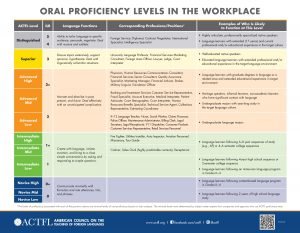
Once you offer language learning to your employees, measuring their improvement in the language skill is essential before you start tracking business outcomes associated with language learning. Language proficiency testing is a more suitable method of measurement than achievement testing, which assess knowledge of context-specific information. A proficiency test evaluates one’s ability to use language to accomplish real-world tasks across a wide range of topics and settings and compares one’s performance against a set of criteria for different levels of language proficiency.

When it comes to assessment tools, the buy-versus-build decision is important for organizations, and time, cost, and convenience are the key factors to consider. Building an in-house test is time consuming and requires specialized assessment expertise in your workforce. Not all tests are created equally. A good language proficiency test needs to be reliable and valid. Reliability and validity of a test are established through a rigorous test development process, which includes describing test specifications and desired statistical characteristics of a test, item writing and review, pilot studies, item analysis, and reliability and validity studies. Besides the cost of test development, ongoing costs exist in online hosting, maintaining databases of test scores, revising items, and continuously collecting validity evidence.

Alternatively, organizations may choose to use commercially available tests, which vendors can implement quickly and host, update, and maintain. Test quality has already been demonstrated with sound psychometric properties and with large volumes of validation data across organizations and countries. In language proficiency testing, organizations do not need tests with the organization’s values and culture embedded, as they would in other talent assessment tools. In other words, organizations do not lose their competitive advantage by using commercial language tests. Neither do companies incur huge test licensing fees, since many testing vendors, like Language Testing International (LTI), provide affordable language proficiency tests. LTI helps organizations measure language proficiency in speaking, writing, reading, and listening, separately or altogether, with certifications in more than 120 languages, online or over the phone, making its proficiency testing available anywhere in the world.

Conclusion

The increasing costs and competition for corporate resources have pushed the need to demonstrate the effectiveness of L&D through various learning impact evidence. Language proficiency testing provides one type of impact evidence that is necessary for receiving business gains associated with language learning. Testing tools can be either bought from testing vendors or built in house. However, comparing the pros and cons of both options suggests that organizations would gain the most by using commercially available language proficiency tests over those built in-house.

References

Helfat, C. E. (2007). Dynamic capabilities: Foundations. In C. E. Helfat, S. Finkelstein, W. Mitchell, M. A. Peteraf, H. Singh, D. J. Teece, & S. G. Winter (Eds.), Dynamic capabilities: Understanding strategic change in organizations (pp. 1–18). Malden, MA: Blackwell.

Training Industry, Inc. (2020, April 1). Size of the training industry. https://trainingindustry.com/wiki/outsourcing/size-of-training-industry

Prove and Improve L&D effectiveness. (2018). In Gartner. https://www.gartner.com/en/human-resources/insights/learning-measurement

Ho, M. (2016). Evaluating learning: Getting to Measurements that matter. Alexandria, VA: Association for Talent Development. https://www.td.org/research-reports/evaluating-learning

Gurchiek, K. (2017 May 3). Language Training Speaks to Improved Business Results. https://www.shrm.org/resourcesandtools/hr-topics/organizational-and-employee-development/pages/language-training-speaks-to-improved-business-results.aspx

Ho, C-H. (2020, December 30). Promoting Diversity and Inclusion in The Workplace: Language Training. https://www.languagetesting.com/blog/2020/12/30/promoting-diversity-and-inclusion-in-the-workplace-language-training/

SIOP Top 10 Work Trends. https://www.siop.org/Business-Resources/Top-10-Workplace-Trends?utm_source=SIOP&utm_medium=Website&utm_campaign=FOWpage&utm_content=FOWpage

5 Ways Language Training Improves Employee Performance. https://www.td.org/insights/5-ways-language-training-improves-employee-performance

Best In Class: Is Your Company Multilingual Enough? https://www.forbes.com/sites/forbesinsights/2017/04/07/best-in-class-is-your-company-multilingual-enough/?sh=4d3c619b63bf

Understanding Proficiency. https://www.languagetesting.com/lti-information/understanding-proficiency

Choosing Effective Talent Assessments to Strengthen Your Organization https://www.shrm.org/hr-today/trends-and-forecasting/special-reports-and-expert-views/documents/effective-talent-assessments.pdf

The Standards for Educational and Psychological Testing (2014 Edition) https://www.apa.org/science/programs/testing/standards.

Hinkin, T. R. (1998). A brief tutorial on the development of measures for use in survey questionnaires. Organizational Research Methods, 1, 104-121.

The Importance of Spoken English in Today’s Global Work Environment

Writing in a language versus being able to speak or converse in a language are two different things. The skill of writing in a particular language can be obtained via classroom instruction, assignments, books, and dictionaries. On the other hand, communicating effectively in spoken English can be challenging, especially when it comes to the pronunciation of certain words and getting the right intonation. One difference between writing and speaking in any language is that while writing one has time to edit or even delete and reword entire sentences or paragraphs. Speech on the other hand is fluid, spontaneous, and it’s not as easy to edit what has already been said.

Knowing how to speak English in a global market can have several benefits. For example, an employee who is fluent in English will benefit by being able to communicate with potential markets outside of a company’s home base. This will simultaneously benefit the employer by helping to expand the employer’s reach and profitability. Given the fact that in today’s economy, money and products are continuously moving between different countries and continents, it goes without saying that a common shared language is important. In many cases, that global language of business is English, which in turn makes it even more important to focus on spoken English.

Many multinational companies seek candidates who are proficient in the English language and who will be able to perform the job successfully. Language Testing International (LTI) has been providing language testing since 1992 to the corporate sector, with industries ranging from retail to hospitality. The assessments provided by LTI are accredited by ACTFL, and are recognized and accepted by major corporations, academic institutions, and government agencies. The tests offered by LTI include speaking, reading, writing, and listening sections. Each test is designed to determine the specific proficiency level that an individual has and ultimately provide a valid and defensible language credential. It is important that any business or organization know whether a potential candidate has the correct level of language proficiency for the position. With LTI, one can be assured that employees and job candidates have undergone the most rigorous language proficiency testing available in the industry. It is also worth mentioning here that in addition to helping organizations select the right candidate for the right position, LTI also has first-hand experience to overcome challenges associated with administrative burden and the cost of the hiring. LTI, by using remote proctoring services, makes language testing more convenient, without conceding the security of the process.

English, at the end of the day, is the global language of science, aviation, computers, and tourism. Additionally, knowing English increases a job candidate’s chances of getting hired at a multinational company, not just abroad but also in their home country. Research has shown that a third of learners in global markets, such as Asia, Europe, and South America, are learning English to apply for jobs in their home country. The same number of people have also learned English to be able to apply for a job overseas. Today, knowing English has become a necessity if one wants to enter a global workforce. Research from all over the world shows that cross-border business communication is conducted in English, and many international and multinational companies expect their employees to be proficient in English. Large global organizations such as Airbus, Samsung, SAP, Technicolor, and Microsoft have mandated English as their official corporate language. In addition, in 2010 the company Rakuten, which is a Japanese cross between Amazon and eBay, made it mandatory for their 7,100 Japanese employees to be able to speak English to be competitive in the world market.

Therefore, the importance of learning, and knowing how to communicate effectively in English in today’s global market cannot be understated.

References

  • Global Business Speaks English – Harvard Business Review (Tsedal Neleey, 2012)
  • Engaging and Integrating a Global Workforce – SHRM Foundation, https://www.shrm.org/hr-today/news/hr-magazine/documents/3-15%20eiu%20theme%202%20report-final.pdf
  • How to Successfully Work Across Countries, Languages, and Cultures – Harvard Business Review (Tsedal Neleey, 2012)
  • The ACTFL English Study – Preliminary Report (June 2016)
  • Assessing Evidence of Validity and Reliability of the ACTFL Speaking Proficiency Test (SPT) (2020)
  • Importance of English in Employment – Deccan Herald (Jyothi, 2012)

Importance of English Language Assessments in a Global Work Environment

With a growing global workforce, English language proficiency has become one of the most sought-after skills. Additionally, given the reliance of multinational companies on an increasingly migrant workforce, with people moving to countries seeking not just new jobs but also career advancement opportunities, the need for fluency in the English language and to be able to communicate effectively has also increased. Therefore, not just to ensure success to organizations that bring in employees but also to enable those employees to be successful, the need for English language testing to examine proficiency level has also increased. These English language requirements, however, range from beginner level to business level and are not only based on an employee’s profession but also the position.

Some important questions regarding proficiency level in English that are usually associated with any job that requires English language skills include:

  1. How well should employees be able to communicate in English?
  2. In an organizational context, how comfortable should employees be with English in order to work on specific tasks successfully?
  3. Does the necessary English proficiency level vary based on the job position?
  4. Is it essential to train employees in English to improve their chances of being promoted?
  5. Does a higher proficiency level in English lead to a better understanding of the culture?

It is important to emphasize that some jobs may require working in a collaborative team environment, or may be more client-focused, therefore requiring a high level of proficiency in English, whereas some jobs may not involve working with people and require only a basic proficiency in English. Having said that, living in an increasingly connected world, does make communication an important part of the process, and people who can communicate well are more likely to grow professionally. Therefore, not only does English language testing enable finding gaps in English language proficiency but also in making hiring and promotion decisions.

ACTFL assessments are largely used worldwide not only by academic institutions but also by government agencies and private corporations to assess hiring and promotion qualifications. Language Testing International administers ACTFL assessments to major corporations and government agencies all over the world. These assessments are designed to result in a valid and trustworthy language credential that reflects an examinee’s language proficiency. By providing four main categories of language testing and assessment, speaking, writing, reading, and listening, these assessments utilize an all-inclusive methodology in assessing language skills and abilities. Given the resources that go into the selection and hiring process in general, it is important for any business or organization to gain information regarding the potential proficiency level of its job applicants when making hiring decisions.. Making decisions about promotions is equally important. Higher level positions usually require employees to communicate with teams and clients, , which makes it essential for them to possess a higher level of proficiency in English, as opposed to employees in lower level positions. Having standardized language assessments in place to examine proficiency will enable organizations to make these decisions in an objective manner. ACTFL assessments can also be utilized to identify specific gaps in the language skills of existing employees expecting to be promoted.

Professionally, the main benefits to conducting English proficiency testing include:

  • Job Success: Studies have shown that employees who score higher on proficiency assessments are less likely to leave the organization, thereby leading to higher levels of employee retention and a more productive and efficient workplace overall.
  • Accuracy: Proficiency assessments are higher in accuracy than observed understanding of language level.
  • Standardized: Proficiency assessments use a standardized scale to measure candidates’ proficiency level, which leads to having a more definite understanding of candidates’ capabilities. This in turn makes is easier to choose the best fit for the position. These assessments also make it easier to compare candidates, thus facilitating the decision-making process.
  • Streamlined Interview Process: By administering a proficiency assessment, before or after an interview, employers can focus on the candidate’s other job-related skills without having to simultaneously gauge their skill in the desired language. 
  • Fair Recruitment Practices: Hiring decisions become more defensible because candidates are measured against a standard, rather than a self-reported or observed or perceived proficiency level.

In conclusion, given the need for employees to be proficient in English in order to be more successful in today’s globalized corporate world, and the benefits that English language testing can have for employees themselves, it is even more necessary for organizations to assess the language proficiency of their prospective or existing employees.

References

  • The ACTFL English Study – Preliminary Report (June 2016)
  • Assessing Evidence of Validity and Reliability of the ACTFL Reading Proficiency Test (RPT) (2020)
  • Assessing Evidence of Validity and Reliability of the ACTFL Listening Proficiency Test (LPT) (2020)
  • Assessing Evidence of Validity and Reliability of the ACTFL Writing Proficiency Test (WPT) (2020)
  • Assessing Evidence of Validity and Reliability of the ACTFL Speaking Proficiency Test (SPT) (2020)
  • https://www.shrm.org/resourcesandtools/tools-and-samples/policies/pages/cms_013464.aspx
  • English communicative events and skills needed at the workplace: Feedback from the industry – Kasim & Ali (2010)
  • Language, Cultural Intelligence, and Inpatriate Turnover Intentions: Leveraging Values in Multinational Corporations through Inpatriates – Frose, Kim & Eng (2016)

The Necessity of English Language Testing Irrespective of Work Location

With the increase of flexible and remote working opportunities, there will be an increase in the number of expats working for global multinational organizations in the coming years. Even though working abroad has never been easier, English language skills continue to be the deciding factor. Without the right level of English language comprehension, finding work or an internship abroad to gain valuable experience is difficult, because a large number of multinational organizations have English as a corporate language, regardless of what part of the world they are headquartered in.

Since English is the most used language in the corporate world, knowledge of English becomes one of the most important employable skills. The ability to express oneself fluently in both oral as well as written English is essential for career growth. It is also essential to understand why English is considered important in the workplace. The answer is that since effective communication is the key to increased sustainability and career advancement in the workplace, it might be difficult for an employee to maintain business relationships and, in the long run, climb the corporate ladder without proper knowledge of the English language. Additionally, English language testing benefits employees by:

  • showcasing their interest to perform beyond basic business standards,
  • enabling them to adequately express and represent themselves in front of an audience
  • allowing them to develop high-end interpersonal and networking skills,
  • providing them with the necessary confidence while delivering presentations and speeches.

To assess the proficiency of English language and to enable employees to carry out essential work-related tasks, proficiency tests are needed that will measure this ability in a standardized manner.

Using LTI Assessments to Make Sure Your Employees Are Competent Enough to Get the Job Done

A task at work usually requires a particular level of language skill to efficiently be able to complete it. Having information about an employee’s language skill level would help organizations assign the right task to the right employee. Having experience working with small- to mid-sized companies, Language Testing International (LTI) works closely with the Human Resources departments of an organization to analyze and understand the requirements of a position they are looking to fill. Once that has been done, LTI identifies the appropriate level of language proficiency required for the position. Thus, LTI helps enable organizations find the right candidate for the right position, which not only benefits the organization but will also allow candidates to be successful in the long run.

In observing todays’ global workspace, multinational companies such as Airbus, Samsung, and SAP, to name a few that have offices the world over, have mandated English as the common corporate language. One of the main reasons for this is to facilitate communication, performance, and business efforts across geographically diverse functions. The competitive pressures faced by multinationals and the globalization of tasks and resources make it essential to have a workforce that possesses the required skills and abilities, especially when it comes to English language, be it spoken, written or even the ability to read the language. Also, with recruitment being one of the costliest, and most time-consuming processes, identifying and interviewing the wrong candidate can become an economic issue. Given the amount of resources that go into the recruiting process, and into making important hiring decisions, it is important to effectively identify the correct candidates to bring in for an interview. Additionally, when reviewing candidates resumes, determining English language ability can be difficult if there is no clear measurement of a qualification. Evidence that 97% of employers in countries where English is the official language, stating that English is vital to their organizations, with the majority needing native, or advanced language skills further underscores the need for standardized English language testing.

References

The ACTFL English Study – Preliminary Report (June 2016)

Global Business Speaks English – Harvard Business Review (Tsedal Neleey, 2012)

How to Successfully Work Across Countries, Languages, and Cultures – Harvard Business Review (Tsedal Neleey, 2012)

Better English for Better Employment Opportunities – (Pandey & Pandey, 2014)

English at Work: global analysis of language skills in the workplace – (Cambridge English Research, September 2016)

Languages & Technology: The New Path to Career Acceleration

The COVID-19 crisis inflicted enormous economic hardships on our workforce. I was furloughed, and many other professionals also suffered furloughs, pay reductions, lost business opportunities, and even layoffs. Yet in the midst of these challenges, it has also created a whole new world of opportunities, enabled by advances in technology and communication. If you are a multilingual professional and have access to basic communication technology, there has never been a better time to shine and thrive.

Multilingual professionals know their skills are highly valued and in high demand. So why are they playing it safe and not exploring the amazing new world of opportunities out there? President Franklin Roosevelt famously said, “We have nothing to fear, but fear itself.” Many professionals are fearful that they can’t find a better opportunity as the job market seems bleak. I can tell you through personal experience that the job market is better than it appears if you have the patience, perseverance, and correct strategy to outshine the competition. I found an amazing new job and interviewed for numerous others as my then current employer announced upcoming layoffs.

How did I achieve this success? There is now a flood of permanently “remote” or “virtual” positions which no longer require close proximity to a physical office. Often these positions only require someone to be within the same or within a couple of time zones from a legacy headquarters, if there are any location restrictions. This is good news for both employers and employees. A study from the New American Economy (NAE) found that demand for bilingual workers more than doubled in just five years! This was great for employers and employees who had office locations or homes in major multilingual hotspots such as Miami, New York, Chicago, or Los Angeles, but was a major challenge throughout much of the rest of the country as multilingual opportunities became much more limited. Now with basic (and often free) telecommunication technology, Wi-Fi, and a computer, a worker can live anywhere and serve an employer or customer living anywhere! That is a major game-changer as the physical presence barrier has come crashing down. I am now employed by a Boston-based company, even though I don’t live in Boston, and I plan to move back to Florida, which is the same time zone.

Of course, that could also mean that competition for such remote jobs can also become more fierce, which is why multilingual professionals need to fully leverage their language skills. I have tried many ways to do this, and by far, the most effective way was to get certified through Language Testing International (LTI). I specifically got my speaking skills in Spanish evaluated. LTI partners with ACTFL, the leader in teaching and testing in languages. Organizations such as Fortune 500 companies, school districts, colleges, and the government use ACTFL/LTI to certify their employees, students, educators, and government officials.  

The LTI certification did two very important things for me, first it gave me a thorough analysis of my actual language skills, which has encouraged me to refocus on improving my language skills so that I can obtain a Superior or Native-like level of fluency. 

Second, it provided me with a certification that I can publish on LinkedIn, attach to my resume, and even frame on my resume. 

An LTI certification is the most effective and efficient manner to advocate your language skills. It is far more cost-effective than a University degree and it gives you the flexibility to go into any industry. During my job search, I was asked about my language skills and I confidently showed my LTI certification showing my Spanish speaking skills. It really helped me stand out from my competition as I did not have to rely on just a “trust me” approach.

 If you are a multilingual professional, take advantage of this potentially lucrative opportunity to find amazing remote positions or gigs while much of the competition sits on the sidelines. Utilize the basic telecommunication tools that you have to access the new opportunities that no longer require expensive and disruptive moves or traveling long distances. Help yourself stand out with an LTI certification to really thrive. Those professionals who can utilize telecommunications technology and effectively leverage their language skills will reap the rewards and prosper.

Learn more about Luis’ experience with language certification:

Growing Up Bilingual as a Heritage Language Speaker

Who is considered a heritage speaker? Heritage speakers are those who have been exposed to their heritage language (i.e., their first language) at home. They are introduced to a second language beginning at a very young age through contact with people outside their home or when they start going to school. Having grown up speaking two languages from an early age, heritage speakers are a great example of the important role that age and timing play in acquiring language proficiency.

How long does it take to learn a language and become proficient?

What is the ideal age to learn a new language?

Is there a time frame or an age at which you reach a ceiling for learning a language?

According to a new study, it may take up to 30 years to fully master a language—even for heritage speakers. Where, when, and how you learn a language are big factors in how proficient you will ultimately become.

In one of the largest linguistics studies ever undertaken, researchers set out to find out approximately when the “critical period” for achieving the highest level of grammatical fluency ends. The study, which was a joint effort between researchers at Harvard University, Massachusetts Institute of Technology, and Boston College, states that we retain the ability to learn language nuances well into our teens; however, we’re constantly improving our language for most of our lives.

If you begin learning a language before 10 years old and continue practicing your language skills, you have a very good chance of achieving a high level of language proficiency in that language. Your chances decrease significantly when you begin learning a new language after the age of 18.

The other important factor to consider is whether the language was acquired formally through a course of study at school, through informal conversations with family members exclusively at home, or through language immersion, which provides the best possible opportunity to become highly proficient. Heritage speakers have great accents; however, having an accent is not a great indicator for language proficiency, and it does not provide insight into the range of one’s language ability.

The length of time an individual has spoken a language makes a difference; in fact, the study shows a slight improvement (about one percentage point) in the grammar scores of people who have been speaking English for 30 years as compared to those who have been speaking the language for 20 years. These findings were consistent in both native and non-native speaking groups.

Although learning a language at home provides an opportunity to become bilingual, without a valid and reliable test, it becomes difficult to ascertain the level of language ability of heritage speakers.

Companies, academic institutions, and government agencies rely on Language Testing International (LTI) for their language testing needs. Each assessment is designed to properly determine the specific proficiency level of an individual, and ultimately to provide a valid and defensible language credential.

LTI works closely with your human resources department to identify the appropriate level of language proficiency required for the position you are looking to fill. Once your needs have been identified, we will help you qualify the right candidates with the language skills needed to be successful.

Call Language Testing International today for a free consultation on how companies are saving time and  money and hiring qualified bilingual talent.


Why Businesses Should Test Heritage Speakers’ Language Skills

Your company’s business depends on the professional communication skills of bilingual employees. How does this play a role in the hiring process? According to the resumes reviewed, many candidates are heritage language users of the languages needed. If these applicants already speak the desired language, why is it important to test their language proficiency?

The United States is linguistically diverse, and by testing your applicants’ language skills, you will open your company and candidates up to more opportunities. Beyond these professional advantages, assessing their proficiency has personal benefits, too. Encouraging heritage language users to learn more about their heritage language also enables them to establish connections to the past while carrying histories and traditions into the future.

What Are “Heritage Language Users”?

The term “heritage” refers to how individuals acquired their language abilities—not to how proficient they may or may not be in the language. For this reason, testing the language skills of heritage language users must be part of the hiring process.

Many heritage language users learn their heritage language in an informal setting (e.g., at home or in their communities) and use that language with family, friends, and co-workers. They may have native-like pronunciation, be confident when dealing with highly familiar topics, and engage freely and fluently on topics related to everyday life. Heritage language users are typically exposed to their heritage language in childhood but may or may not have learned the language to its full functional capacity because another language became dominant in their day-to-day interactions. They may have never even received formal education in their heritage language. In fact, heritage language users residing in the U.S. have typically received most of their formal education in English-speaking schools, and for this reason, they may not have all the functional abilities in their heritage language that they have in English.

While heritage language users may be more fluent in a second language, such as English, they are at an advantage compared to language users starting without any background knowledge. Heritage language users already have exposure to their first language and culture, making it easier for them to learn or relearn their heritage language.

The primary importance of heritage language is that it allows individuals to connect culturally and linguistically to their ancestors. Being proficient in a heritage language also offers professional benefits and opens the door to more job opportunities.

Heritage Language Users and Language Proficiency

The term “heritage” does not indicate or predict any specific proficiency level. Heritage language users’ extensive exposure to the language in informal contexts may result in profiles that differ from those of traditional second language users. Nonetheless, their functional ability of language is assessed according to a common set of criteria, which corresponds to a given proficiency level. Their language skills can be assessed at any level of the proficiency scale as described in the ACTFL Proficiency Guidelines – 2024.

With ACTFL assessments, heritage language proficiency is fluid, and each level has specific criteria and descriptions, so the heritage speaker has information on which level they are at in each skill. The main difference between each level is the language user’s ability to communicate, read, listen, or correspond through writing to native language users while contributing their thoughts and ideas to the conversation.

Different Levels of Language Proficiency

The language proficiency of a heritage language user can differ from second language speakers depending on their exposure level to their heritage language. For example, a heritage speaker at the Intermediate level may have the same proficiency skills as an intermediate second language user regarding lack of vocabulary and limited structural control. However, in some cases, heritage language users can be at the Intermediate level and still possess a higher level of fluency and confidence than Intermediate second language users.

Advanced-level heritage language users typically perform Advanced-level tasks with quantity and quality. Their native-like pronunciation and fluency, as well as their extensive vocabulary and structural control, may distinguish them from their second language user counterparts. When asked to perform tasks at the Superior level, Advanced-level heritage language users may not demonstrate errors in language control nor diminishing fluency but rather may avoid addressing a Superior-level task. For example, rather than supporting an opinion, they may provide anecdotal information; rather than discussing a topic at the issues level and from an abstract perspective, they may resort to a concrete treatment of the topic; rather than speculating on possible outcomes when asked to hypothesize, they may describe a real situation.

Heritage language users at the Superior level demonstrate the ability to sustain the Superior-level tasks in extended discourse, using precise vocabulary, and with no patterned errors. They are not rated Superior because of the way they sound but rather because their ability to use the language effectively falls within the functional requirements for that level.

Reasons to Test Heritage Language Users

Why, then, should businesses test heritage language users’ language skills? The term “heritage” does not identify what language users can do with language, nor does it indicate how well they can communicate in different situations. Simply identifying oneself as a “heritage speaker” of a language does not provide evidence to a prospective employer as to whether that person has the language skills appropriate for the demands of the workplace. Official testing of language abilities does provide this information. Testing heritage language users, using official ACTFL assessments and reporting results based on the ACTFL Proficiency Guidelines, enables employers to have confidence in their hiring decisions.

Testing proficiency in a heritage language is an excellent way to reduce time-to-hire and the cost-per-hire whether you are looking for candidates internationally or for specific language positions. Language testing measures specific elements of languages and gives data you can use to make the best hiring decisions. High test scores also indicate how likely an employee is to be successful in their position, which may aid in improving retention rates.

Test Heritage Speaker Proficiency With Language Testing International®

Improve your hiring process with Language Testing International®. We are the exclusive licensee of ACTFL and offer various commercial and official testing options. Each ACTFL assessment offers accurate proficiency scores to enable employers to compare testing abilities with linguistic requirements and hire heritage language users with confidence.

Since the creation of Language Testing International (LTI) in 1992, we have been a leader in language proficiency testing. Our ACTFL language assessments are under full accreditation and are widely recognized and accepted by academic institutions, corporations, and government agencies. We invite you to complete our online contact form to learn more about our wide range of testing options for heritage speakers and other language users.

Languages Can Help Reopen the United States

The COVID-19 crisis has caused drastic lockdowns of major sectors of the American economy in order to stop the spread of the virus. As the curve begins to flatten and states are allowing a phased reopening of local economies, we cannot forget how important qualified language professionals will be in helping ensure that the reopening is done effectively and safely.

Small businesses have been especially hit hard by the lockdowns, with much of the pain being felt by minorities. According to the United States Senate Committee on Small Business and Entrepreneurship, minority owned businesses “accounted for more than 50 percent of the two million new businesses started in the United States and created 4.7 million jobs. There are now more than four million minority-owned companies in the United States, with annual sales totaling close to $700 billion.” Over 99.9% of minority owned businesses have fewer than 500 employees.

The COVID-19 crisis has also heavily affected minority communities. African Americans are about 3.5 times more likely than white Americans to die from COVID-19, and Latinos are about two times more likely to die from the virus than white Americans. Even before the epidemic, minorities faced numerous obstacles gaining access to healthcare. As the debate rages on about if and how to reopen the economy, policymakers, health experts, and community activists will need to develop a plan to reopen the economy in a safe manner that limits exposure to the virus, especially among hard-hit minority communities.

The importance of languages to the success of such plans cannot be overstated. With effective language strategies, we can help minority owned businesses and communities recover from the devastating effects of COVID-19 and ensure that the re-opening process does not backfire. Governments, businesses, healthcare facilities, and nonprofits need to ensure that their people and communication strategies can effectively deliver the crucial messages that need to be conveyed. As Nelson Mandela stated, “If you talk to a man in a language he understands, that goes to his head. If you talk to him in his language, that goes to his heart.”

We must first remember that English is not the official language of the United States, in fact, there isn’t an official American language. American citizens are free to speak to each other in any language they so choose. Over 35 million American citizens (over 66 million if including non-citizen residents) speak a language other than English at home. Of that population (including non-citizens and residents), over 60% can communicate in English “very well.” That means that about 26 million Americans do not speak English “very well.” These statistics are important to the reopening of the United States, because these Americans also own businesses and live in communities hit hard by COVID-19.

In order to truly understand complex instructions and regulations that deal with healthcare, personal safety, and business, someone would need to speak English “very well.”  Peoplenot understanding these instructions and regulations due to a language barrier could put their life, and potentially the lives of others, at risk. Effective government and healthcare recommendations will mean nothing if significant portions of the American population are not able to understand and take them to heart due to a language barrier.

Local leaders, especially, can lead the charge in reopening the United States, because they know their communities better than federal officials in Washington D.C. or even than their own state governments. They can identify the key language groups in their communities and encourage translation of resources and instructions from the government and healthcare providers to those groups. Local minority owned businesses are often the cultural and commercial hubs of the community they serve. For example, growing up in Miami, Florida, I saw that there were numerous Cuban restaurants that acted as informal community spaces and news often spread within the community through these restaurants, and always in Spanish. This happens all across the United States through nearly every community with a concentration on a specific ethnic group.

Failure of translating these resources can lead to harm, but mistranslations and errors in interpreting can also be equally devastating. Language professionals who undertake the efforts to properly communicate with minority businesses and communities need to have a high level of language proficiency in the languages of those communities to faithfully translate complex resources. If there are mistranslations, people can be seriously harmed and legal liabilities may arise. For example, if a minority business owner who does not speak English does not understand instructions for keeping his or her employees safe and an employee gets ill, the business may get shut down, the owner may go to jail, the employee’s health may be put at risk, and other employees may lose their jobs. There are many very real examples of lawsuits filed due to mistranslations, and a death due to a mistranslation is simply an unnecessary death.

That is where Language Testing International (LTI) can help. LTI is the exclusive licensee of ACTFL assessments, widely recognized and accepted by government institutions, healthcare professionals, and businesses across the world. Thus, it is a perfect standard, as those key sectors will need to work together to address language barriers that may affect the reopening of the United States and ensure that their messages are effectively communicated without the risk of liabilities due to mistranslations.

The reopening of the United States will take time, and many lessons will be learned along the way. Special attention will need to be paid to minority businesses and communities to address the devastating effects of COVID-19. Languages are absolutely critical to the success of the reopening, and our leaders will need to ensure that all Americans, including those who are not fluent in English, are truly able to understand the messages needed to guide us to recovery. Partnering with LTI would be an effective strategy to achieve these goals.

Closing the Communication Gap on COVID-19

COVID-19 may be “coronavirus” in every language, but how we, as a global community, address it requires healthcare professionals who speak the native languages of the patients they care for and the diverse communities they work in. Language proficiency has become a fundamental skill for healthcare teams charged with communicating and sharing coronavirus precautions more effectively. How is your organization evaluating the language proficiency level or your multilingual employees?

While the coronavirus disease (COVID-19) is a household term these days, the provision of culturally and linguistically competent patient care is a challenge faced by healthcare professionals and agencies alike. For example, healthcare workers in diverse communities must quickly learn how the coronavirus spreads, how to protect themselves, how to help people prevent infection, how to care for patients that present symptoms, and so on. Considering that there have been confirmed cases in over 148 countries (UNifeed, 2020), all composed of multiple cultures, languages, and norms, it is easy to see how complicated the situation becomes for healthcare organizations when faced with communicating critical information to their multilingual patient communities.

Although English is the primary language of communication in the United States, there is a critical need and urgency for linguistically appropriate ways to communicate information regarding this pandemic; it literally has become a matter of life and death. The bottom line is that this crisis requires us to communicate on a global scale. Currently, basic vetted public information about coronavirus can be found in fifteen languages (Washington State Department of Health, 2020), including Spanish, Chinese, Arabic, Hindi, Japanese, Korean, Russian, and Vietnamese. However, the need for communicating this information accurately and effectively is much greater than just making it available in fifteen languages on the Internet or in printed materials!

Healthcare providers are asking themselves: Do we have employees on staff who can help us communicate in a culturally and linguistically appropriate manner to meet the needs of our patients? With a global literacy rate of approximately 86% (meaning 14% illiteracy rate; Roser & Ortiz-Ospina, 2018) varying by country, literacy levels in reading, writing, and comprehension can have an impact on the level of readiness to combat coronavirus.

To add to the complexity of the situation, “health literacy” levels are low. “Health literacy,” as defined by the Institute of Medicine’s report Health Literacy: A Prescription to End Confusion, is “the degree to which individuals have the capacity to obtain, process, and understand basic health information and services needed to make appropriate health decisions” (National Network of Libraries of Medicine, n.d.). According to the Program for the International Assessment of Adult Competencies (PIAAC), only 12% of U.S. adults scored in the highest healthcare literacy proficiency levels (National Center for Education Statistics, n.d.).

Based on the data, to truly ensure that culturally diverse people, communities, and countries can enhance their understanding of what is involved in preventing and treating the coronavirus disease, it essentially comes down to healthcare professionals who can communicate in languages other than English.

Since 1992, Language Testing International (LTI), a Samsung company, has been a leader in the development of language proficiency testing for more than 120 languages, globally. In partnership with the ACTFL, we proudly offer our healthcare partners valid and reliable reading, writing, speaking, and listening tests. Each test is designed to properly determine the specific proficiency level of an individual and ultimately to provide a valid and defensible language credential.

LTI works closely with your human resources department to identify the appropriate level of language proficiency required for the position at hand. Once your needs have been identified, we will help you qualify the right candidates with the language skills needed to be successful.

Contact us today for a free consultation on best practices for hiring multilingual talent!


References

National Center for Education Statistics. (n.d.). What is PIAAC?

National Network of Libraries of Medicine. (n.d.). Health literacy.

Roser, M., & Ortiz-Ospina, E. (2018). Literacy.

UNifeed. (2020). WHO/COVID-19 update.

Washington State Department of Health. (2020). Novel coronavirus fact sheet.


Leverage Your Credit Union’s Language Skills

As our communities become more diverse and connected to the global commerce, credit unions will need to ensure they leverage their language skills to remain competitive. Languages are not a “nice-to-have” skill but an absolute necessity for succeeding in diverse markets and reducing risks associated with language miscommunication. Languages will be among the most important skills to develop for many credit unions in our changing economy.

While the United States has historically focused on just speaking English, multilingualism is growing rapidly. From 1980 to 2018, the percentage of multilingual Americans nearly doubled from about 10.68% to about 20.55%. One factor that could explain this is that the United States is generally becoming more diverse. For example, since 2000, more than 109 American counties have become majority non-White. Another potential explanation is the realization that multilingualism, even if English is one’s native language, brings enormous benefits to an ever increasingly globalized economy. The New American Economy think tank produced a study showing that demand for multilingual workers has more than doubled in five years, including for both low- and high-skill positions. Studies in Europe have illustrated the macroeconomic impacts of speaking foreign languages. Switzerland estimates that 10% of its gross domestic product (GDP) is generated from its multilingual skills, while the United Kingdom estimates that a lack of multilingual skills has cost them over 3.5% of its GDP.

Credit unions are perfect examples of institutions that need to develop language skills. They offer complex products and services to consumers to help them achieve their financial goals, and they are focused on serving their communities and members, not shareholders. As our communities become more linguistically diverse, credit unions need to be able to effectively communicate their value in the languages spoken by their members. The large banking institutions understand the value of languages, as the New American Economy report showed that more than a third of Bank of America’s job postings online required foreign languages skills.

There are enormous benefits for credit unions to reach into multilingual markets. I grew up in a majority Latino community, and both of my parents are Latin American immigrants whose first language is Spanish. Firms that could not effectively communicate their value or serve their customers in Spanish did not do well in my community. Immigrant communities in general are underserved by financial institutions. The Federal Deposit Insurance Corporation reports in 2017 that Latino, African American, and immigrant communities have higher percentages of members being unbanked or underbanked than the overall American population. As the spending power of these communities grows, these markets will only become more lucrative for credit unions.

Ineffective language skills are a major risk to firms and credit unions. The United States Committee on Economic Development estimates language and cultural misunderstandings cost American businesses over $2 billion dollars per year. Due to the complex nature of financial products and services, and the potential detriment they can cause if mismanaged, financial institutions have been held accountable for not providing adequate language services to those who don’t speak English. Wells Fargo was accused of not providing Spanish-speaking loan officers and taking advantage of Spanish-speaking borrowers by steering them to more expensive and higher risk loans.

So how do credit unions effectively leverage their language skills to achieve the benefits mentioned above? Although credit unions can contract for translating services, it is often an expensive option that may not provide the flexibility credit unions need. Instead, credit unions should hire multilingual staff to serve their customers who don’t speak English. How do you ensure that your staff is proficient enough in language to communicate important and complex product information and services? A valid and reliable language proficiency credential from Language Testing International (LTI) will guarantee that candidates have undergone the most rigorous language testing and assessment in the industry. LTI offers language certifications developed by ACTFL that are widely trusted, recognized, and accepted everywhere.

Leveraging language skills will benefit credit unions by being better able to serve their customers, grow into multilingual markets, and reduce their language communication risks. Credit unions should not ignore the importance of language skills if they don’t want to be left behind by their competition.

About Language Testing International

Since 1992, Language Testing International (LTI), a Samsung company, has been the leader in the development of language proficiency testing for more than 120 languages, globally. In partnership with ACTFL, we proudly offer our corporate clients valid and reliable reading, writing, speaking, and listening tests. Each test is designed to properly determine the specific proficiency level of an individual and ultimately to provide a valid and defensible language credential.

From Fortune 500 corporations to small and midsize companies, LTI works closely with your human resources department to identify the appropriate level of language proficiency required for the position you are looking to fill. Once your needs have been identified, we will help you qualify the right candidates with the language skills needed to be successful.

Contact us today for a free consultation on best practices for hiring multilingual talent!